
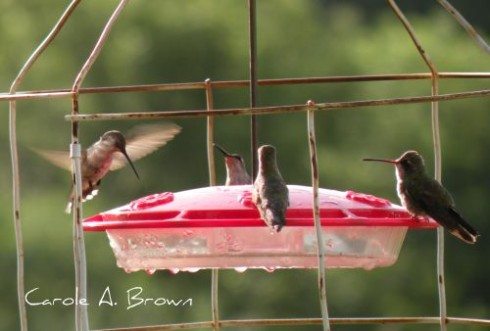
I was recently asked:
“Should we still be feeding the hummingbirds? I wasn’t sure when to discontinue our feeders so the hummingbirds can move on for the winter.”
It’s a good question.
Actually when it’s time to migrate, it’s time to migrate, no matter what: feeders full of fresh solution or gardens full of flowers. Most Ruby-throated Hummingbirds have already migrated south (big numbers moved through late July through early September). They left and my garden was still in full flower. That said, I still maintain a few feeders and keep them 1/2 full (no need to fill them to the top this time of year). I will continue to clean & refill them with fresh solution every week (if the temperatures are cool) or every 3 days (if the temperatures go up & the days are hot) through early December, maybe even later.
Why? Because there may have been a few late Ruby-throated Hummingbird nests and some late youngsters still moving through. Also because NOW is when rarities show up, hummingbirds from the west. Cape May County has documented many Rufous/Allen’s Hummingbirds, like the one found TODAY by Cynthia Allen in her garden in Cape May Court House (Cape May County), NJ (see the photos). The rusty sides are a give-away that it’s NOT a Ruby-throated Hummingbird.
Western hummingbirds that have been documented here (nearly all very late in the fall or early in the winter) include: Black-chinned, Calliope, Allen’s, Rufous, and some that are either Allen’s or Rufous Hummingbird, but can’t be ID’d for sure like the one seen today.
So, YES, keep a feeder or two or three up and see what you attract. The western hummingbirds that appear might be young-of-the-year and not in jazzy, breeding plumage, so look closely at ANY hummingbird that comes to your feeder this time of year and, if it looks a bit different, be sure to report it to the Cape May Bird Observatory or another group of birders near where you live that might be able to positively ID it for you.
Enjoy your late fall garden. Mine is still full of blooming salvias (thanks to Ward Dasey), New England Asters, Seaside Goldenrod, Mistflower, and more.


Submit your review | |