
It makes me so happy to walk through my garden right now, because the Carolina Chickadees have hatched. I could sit by this nest box for hours listening to the happy cheeping sounds coming from hungry baby Chickadees inside the box. Mom and Dad work diligently from dawn to dusk on a constant mission to feed their hungry offspring.
With 7 species of Chickadees native to the US, you should be able to easily attract them to your wildlife garden no matter where you live.
- Here in my Philadelphia garden I’ve got Carolina Chickadees (Poecile carolinensis), which range from southern Pennsylvania south to Florida and west to Oklahoma and Texas.
- Just to the north you’d find the Black-capped Chickadee(Poecile atricapillus), which is the most widespread species of the bunch, ranging from Atlantic Canada south to Pennsylvania and down into Appalachia, and west to Alaska and south to Oregon.
- The Mountain Chickadee (Poecile gambeli) ranges from British Columbia south to west Texas and west to inland California, Oregon and Washington.
- Chestnut-backed Chickadees (Poecile rufescens) range along the West Coast from Alaska to Northern California.
- Mexican Chickadees (Poecile sclateri) can only be found in the Chiricahua Mountains of Arizona and the Animas Mountains of New Mexico.
- The Gray-headed Chickadee (Poecile cincta) is only found in the far north of Alaska and northwestern Canada.
- Boreal Chickadees (Poecile hudsonica) are specialists of the far-northern or high-altitude boreal spruce-fir forest. They use both young and mature forests, from Eastern Canada to Maine and west through Canada to Alaska.
Chickadees are extremely friendly. When we first moved in to this house, a pair of Chickadees would perch on a wooden post in the garden every time we went outside. They would sing and chatter incessantly as if to say, “this would be a really good place to hang a feeder.”
Needless to say, we did just that. And a nest box just for them. What a joy to be rewarded for our small offerings by baby Chickadees later that season. And they’ve nested in the garden every year since.
Most Chickadees do not migrate, so you want to plan for their needs for the breeding season as well as winter.
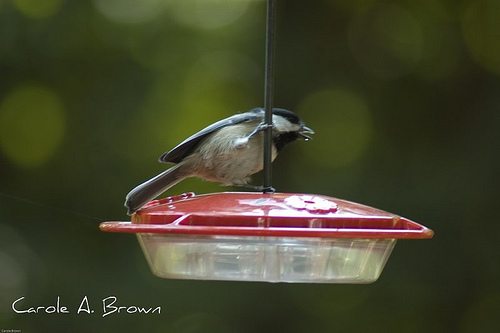
Water is one of the main elements for attracting Chickadees to your wildlife habitat garden. As you can see in the photo above, they are very creative in how they obtain water. This one learned to drink from the antwell in my hummingbird feeder. Water in winter is especially important.
Chickadees are generalist feeders, eating insects, seeds, berries,fruits, and nuts. And we gardeners owe a debt of gratitude to these common birds who feast on insects that target trees, from ants and aphids, to beetles, caterpillars, and moths.
Small native trees and shrubs, especially those that also produce seeds, nuts, or fruits are great for attracting Chickadees to your garden, as are sunflowers, both annual and perennial and coneflowers.
Please check out The Ultimate Guide to Birdscaping Your Garden for a treasure trove of information to make your wildlife garden a haven for birds.
More From Ecosystem Gardening:


Submit your review | |