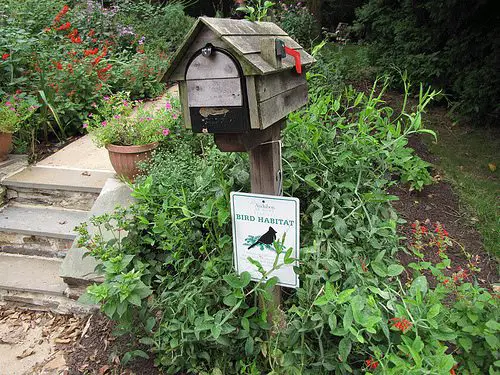
We’ve talked before about the process of certifying your wildlife habitat with the National Wildlife Federation, but aside from the pretty sign, is there a benefit to you for doing this?
In a word, yes!
But before we go into that, did you know that there are many other ways to certify your habitat garden?
Here’s a few:
- The North America Butterfly Association Butterfly Garden and Habitat Program has an exhaustive resource area for butterfly gardeners, including garden ideas, host plant lists, suggested plants, and regional gardening guides.
- Canadian Wildlife Federation‘s certification is similar to that of the National Wildlife Federation
- Monarch Watch Waystation Program is a great way to create stopover spots for Monarch butterflies during their amazing migration and for breeding new generations.
- Many state divisions of the National Audubon Society have habitat certification programs. For example, here is Pennsylvania’s and Oregon’s. Check with your local Audubon to find the program for your state.
- Many townships and cities have habitat certification programs specific to your immediate area. Your local nature center will probably be the best place to get this information.
While I have several friends who have certified their gardens in ALL of the above ways, you probably want to pick just one to start with.
The Benefits of Wildlife Habitat Certification
- As you go through the process of certification, take a good look at all suggestions in the materials. You will discover many tips and ideas that you could easily add to your garden.
- Every small action you take can have major benefits for the critters in your area. The certification process will help you find many small actions that you can easily implement.
- The sign that announces that your garden is certified is not just about your pride. However, you should always be proud of your choices to protect wildlife. By doing just one thing, you have already done more than most people in this country. Congratulations! You are making a difference.
- But the sign is a very useful way to start conversations with your neighbors. Often when neighbors see your sign, they will ask you questions about what it means. This is the perfect way to begin to encourage them to make more positive choices, too. You can begin to teach all of your neighbors about the joys of sharing your space with birds, butterflies, pollinators amphibians, and other critters.
- And, finally, purchasing your sign is a great way of supporting these organizations who are doing great work in protecting wildlife.
Is your garden certified? Are you certified with more than one organization? How are you creating habitat in your garden?
© 2010, Carole Brown. All rights reserved.


{ 6 comments… read them below or add one }
I have a NWF sign in my yard, but I have to admit some serious cynicism about it. I bought the sign to alert curious neighbors about the relative messyness of my yard. I’m simply not a good enough gardener yet to have an ecologically sound garden that is also beautiful enough to turn heads. The sign is a band-aid for this problem. The actual “certification” that comes with the sign is laughable. Anybody can get a sign, just by clicking the half-dozen obviously correct answers on their online survey. I know one woman who grows English ivy, an invasive nusance, for the purpose of feeding the deer – and she is convinced that she is doing a good thing. And she is SO proud that her yard is “certified”.
It’s a good thing that my neighbors don’t know the dishonesty behind my sign.
Michelle Clay´s last blog ..Okay, the mess has been tidied.
Michelle, this is exactly what I was referring to in the first part of this series, Certified Wildlife Habitat #35038 Several others have expressed similar feelings, but Kelly Senser, the Wildlife Gardening editor of National Wildlife Magazine is trying to bridge this gap by bringing much better information to the magazine. Like I said in the comments of that post, I am keeping my fingers crossed!
A little history: It was actually a 1973 National Wildlife magazine article that provided the basis for NWF’s habitat program. Then managing editor George Harrison invited two Forest Service researchers who were studying ways to convert suburban yards into mini-habitats for birds and other wild creatures—Richard DeGraaf and Jack Ward Thomas (who later served as chief of the U.S. Forest Service)—to write an article describing the steps homeowners could take to create such havens. Many of the wildlife gardening articles that have appeared in the magazine since are available online (see archives). Lots of good information for those who seek it!
Thanks, Kelly. I’m on my way to check it out!
I read the first part of this post and while I agree certification is rather easy – anyone can click on answers, pay $25 and get a sign, the program has been an amazing success as far as awareness goes. I know non-gardeners who have honestly considered what they landscape with just because they want that sign. The majority of people just need a neat landscape design to keep HOAs happy, they don’t live for their yards like we do. However the NWF has brought the idea of “backyard habitat” to a pubic level which I am not sure anyone else could accomplish. I’ve seen normally unaware people who would just plant what they saw at big box nurseries really, really exited about a “bird sanctuary” shrub. Congratulations NWF for that and THANK YOU. I have also seen neighborhood projects where public areas get certified and the community is quite proud of it.
I would like to see levels of certification, yes, but haven’t an idea how it could be done. It would require visitations to individual gardens by volunteers – the manpower and upkeep would be staggering. I live in the boonies. Not sure I could find an NWF volunteer to come visit my garden. Just hand me my Hard Core badge now! My state native plant society has a certification program which requires a site visit – well, it’s a minimum of 2 hour drive for the nearest qualified volunteer to come out. I’m not asking anyone to do that so I can have a native plant sign. Meanwhile, the NWF Backyard Habitat program works for the average person.
Karyl´s last blog ..Ilex verticillata Winterberry Holly Native Plant for Bird Gardens
Karyl, I agree that the strength that NWF has is that is has brought such awareness to people that they are making better choices. I also share some of Michelle’s frustration in that for some people, the “sign” can be a meaningless joke if people don’t take responsibility for removing invasive plants and actively seeking out better information.
Back in the 90s and early 2000s authors and organizations, including NWF, were actually recommending planting invasives because they were supposedly great for birds like Oriental Bittersweet, Russian Olive, and Japanese Honeysuckle. This is where my frustration began because I was being hired to create wildlife habitat for people and 90% of what they were paying me for was to remove these plants that had consumed their whole yard.
I am very happy to see that finally many so-called experts are waking up to the dangers of invasive plants and are making better recommendations. It is unfortunate, though, that many who are jumping on the “habitat gardening” bandwagon (Jerry Baker for example) continue to promote old lists of plants for birds that continue to promote these invasive plants.
As for levels of certification, I’m not sure that NWF would find that feasible. Maybe it is up to us to continue to work to help people go deeper, to make the certification much more meaningful. I will continue to try to do my part, as I know you are also. Thank you for all that you do!
{ 1 trackback }