

Imagine my surprise when, on the last full day of my vacation in the mountains of the Lehigh Valley in Eastern Pennsylvania, I discovered that the town in which I had been staying, Palmerton, PA, was the site of one of the largest EPA Superfund clean-up sites east of the Mississippi River. This is a story about contamination, but also a story of hope and restoration.
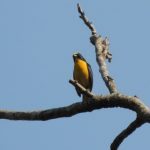
Sure, I had noticed that the ridge behind the house, Stony Ridge, was covered with dead trees, that the mountain in front of the house, Blue Mountain/Kittatinny Ridge had huge spots that were completely devoid of vegetation, and we had discussed our confusion about why we had not seen any mammals on the ridge (no chipmunks, no squirrels, no deer) but I hadn’t completely connected the dots until the last day. The new, shrubby habitat that was growing on the ridge was actually great for one endangered species, the American Kestrel, whose population has plummeted in recent years. We were blessed every evening by the sight of several Kestrels perched around a shrubby field on the upper tips of the dead trees.
New Jersey Zinc
It seems Palmerton has a checkered past. The town was established in 1898 as a company town for New Jersey Zinc, and named for then president, Stephen S. Palmer. It was located at the junction of the Lehigh River and the Aquashicola Creek to take advantage of this proximity to the anthracite coal being mined just to the north and the zinc mines in Franklin, NJ.
It is evident from the name “Aquashicola” that this land was the home of Native Americans from the Lenni Lenape tribe until the time of European settlement. The taking of this land from the native tribes was the subject of a contentious dispute, called The Walking Purchase, in which the Lenape tribes felt they had been horribly wronged by the European participants.
New Jersey Zinc opened two zinc smelting plants in the town of Palmerton. Although several garment manufacturing plants also came to Palmerton, the zinc plants were the primary employer of the town’s residents. These plants were in operation from 1898 until 1980, when the main plant was shut down because of a poor zinc market and new environmental regulations. The smaller plant continues operations today in a reduced capacity, processing electric arc furnace dust into zinc calcine.
One of the first EPA Superfund Sites
Due to the geography of this site (between two mountain ridges) and a lack of pollution control technology at the time, pollution from these zinc smelters destroyed vegetation on 3,000 acres surrounding the town, much of it on the Kittatinny Ridge at Lehigh Gap. In 1983, the site was designated one of the nation’s first Superfund sites, making it the target of a U. S. Environmental Protection Agency (EPA) mandated clean-up. Toxic heavy metals from the smelting contaminated the top 6-8 inches of topsoil, rendering it sterile.
This contamination had a devastating impact, not only on the vegetation, but on salamanders, frogs, toads, birds, and mammals, as well as contaminating the groundwater and local streams. Over 300 homes also had to be decontaminated as part of the clean-up because of high levels of lead and arsenic.
Now, I know at this point you are thinking “what can this possibly have to do with my garden?” And I want to share the hopeful side of this story: the restoration. Keep in mind that the smelter was shut down in 1980, and the deforestation, erosion, and lack of vegetation from the contamination is still in evidence now, 29 years later (remember all those dead trees I noticed).
Hope and Restoration: the Lehigh Gap Nature Center
Beginning in 2002, the Lehigh Gap Nature Center was established and has embarked on an ambitious restoration plan which has three phases: 1) acquire more than 750 acres of land along the Kittatinny Ridge at Lehigh Gap; 2) restore degraded portions of the refuge and manage habitats for maximum biodiversity; and 3) open the Refuge to the public and create a community nature center for environmental education, ecological research, and outdoor recreation.
I’m happy to report that Lehigh Gap Nature Center now owns this land, restoration is under way, and the nature center is being built and will be opening soon. This organization has devoted itself to the ecological restoration and habitat enhancement along this mountain ridge, the protection of this hawk migration corridor (Hawk Mountain Sanctuary and Bake Oven Knob Hawkwatch are located along this ridge), promoting wildlife-friendly habitat gardens, promoting sound land use, providing public education on environmental issues, and advocating preservation of biodiversity.
Using innovative methods of planting, the Nature Center, in partnership with EPA and responsible party Viacom International (now CBS operations), was able to establish native, warm-season, zinc tolerant, prairie grasses on its part of the Superfund site. These methods have been used on most of the other land in the Palmerton Superfund area, which is becoming green again for the first time in 50 years. Research is now under way to study the progression of ecological succession from these prairie grasses to an environment which has re-established fully functioning ecosystem services.
You can view a slideshow of the restoration at the Lehigh Gap Nature Center site. Keep in mind that this restoration is enormously expensive, and the Nature Center is dependent on member contributions. Please support them if you can.
Follow updates of the clean-up at the PA EPA site .
Hope in Your Conservation Garden
The above story is an illustration of human action gone horribly wrong to the environment, but also a story of hope and restoration (albeit enormously expensive). Your Conservation Garden can also become a story of hope and restoration: a giving back to the environment and the wildlife that depends on it.


Submit your review | |
Thank you for this article about my hometown. I grew up in the rural portion of Palmerton and the devastation done by the NJ Zinc Company was appalling. My father was an employee of the company for a time and I remember the respirator filters he wore being caked with powdery residue. The air often smelled like sulphur, the landscape was barren and wildlife non-existent. I can say I've seen an improvement in the landscape over the years. The only error I saw in the article was the spelling of a community, it's actually spelled Aquashicola.