
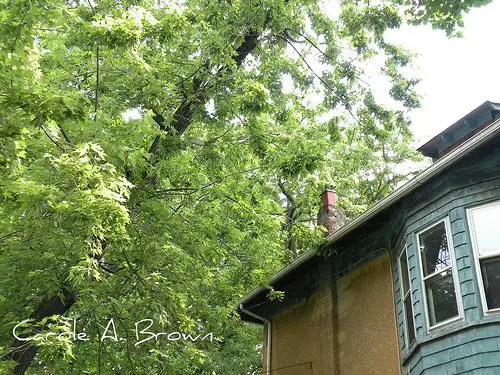
Norway Maple threatens my roof
You may have noticed by now that invasive plants make me a little angry as well as the people who continue to plant invasives, and especially the people who continue to sell invasive plants. Or rather, they really TICK ME OFF.
So I’m going to start a new series in which I highlight a specific invasive plant, where I’ll discuss what makes that plant such a problem and how we can eradicate them from our landscapes.
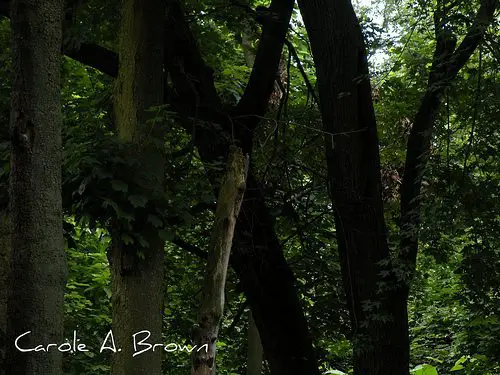
Norway Maple top snapped off, resprouting from trunk
The plant that is inspiring my anger this week is the Norway Maple (Acer platanoides) because my neighbor has a whole yard full of them and he has no interest in maintaining them or eliminating the danger that they present to my roof.
This tree was brought to America by the famous botanist of Philadelphia, John Bartram. During the 1930s and 1940s when the streets of many cities lost their shade trees to Dutch Elm disease, Norway Maple was widely used as a replacement because of its fast growth and deep shade.
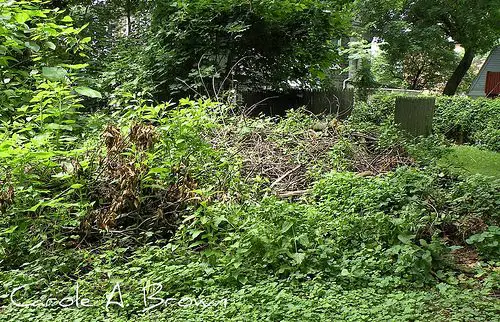
Brush pile of Norway Maple fallen branches
Norway Maples continue to be sold throughout the country as ornamental shade trees. I continue to hope that someday soon Home Depot (and Lowes and Walmart) will awaken to the harm they are causing the environment by continuing to sell invasive plants. Maybe one day responsibility will win out over profits.
Here’s why I hate Norway Maples:
This is one dirty tree, dropping trash at all seasons, including flower buds, two crops of seeds, twigs, branches, and copious amounts of leaves.
It sheds large branches from the top, then resprouts along the truck. Every time the wind blows large branches fall from the top of the tree, making me very nervous about my roof.
It makes a LOT of seedlings. I spend way too much time every spring and summer in an attempt to hand pull all of them.
Nothing grows underneath them. My flower beds along this neighbors fence line are empty. Every year I try to fill in these beds, and every year I watch in sadness as everything dies.
It is the last tree to lose its leaves in the fall, often not until after Thanksgiving, which means that having my gutters cleaned is a game of Russian roulette. Will the leaves fall before it snows? It’s been a hit and miss proposition.
I fear for my two dogs safety when they are in the yard. One of those falling branches would hurt them badly.
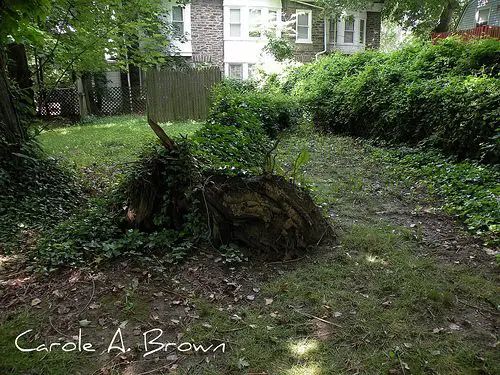
Norway Maple blow-down
Norway Maples have severe environmental impacts:
They grow faster than native maples and other forest trees and its dense, shallow root system makes it difficult for native seedlings to get established.
They create a dense shade, under which other species cannot survive, hence my naked garden beds.
The seedlings are very shade-tolerant, able to spread and grow in interior forests. These seedlings are usually the only plant that can survive in the shade of mature Norway Maples.
Forests with Norway Maples show much lower species diversity than forests that have not yet been invaded.
Its shallow roots make it prone to blowdowns.
It is tolerant of poor soils and air pollution, making it the dominant tree in many urban settings.
Eradication of these trees requires a huge amount of labor. Seedlings can be hand pulled, and mature trees cut down, but it often resprouts again from the stump. This may be accomplished in my small city yard, but the cost is prohibitive in woodland and forest settings.
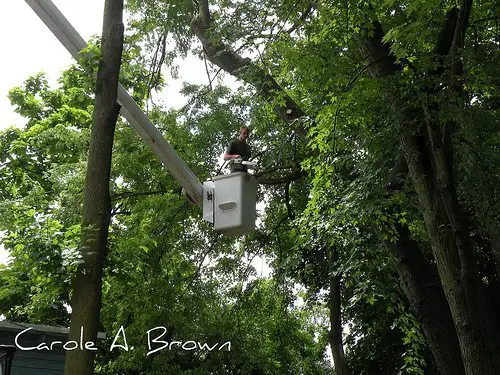
Happy Day! Norway Maple Removal
Please do not ever intentionally plant this tree!
The good news is that my neighbor has basically abandoned this house and a very happy day for us was when we had these trees cut down.
A wonderful reference to the impacts and eradication of other most hated plants is Invasive Plants: Guide to Identification and the Impacts and Control of Common North American Species.
Leave Us Your Comments Below!
Click the Create your own review button below to leave a comment!
StopClimateChange.net – do your part and help with climate change
Take a break from gardening and play the Enchanted Garden game at SlotoCash! Redeem the SlotoCash no deposit bonus code at https://usacasinocodes.com/slotocash-coupon-codes/ and get a $31 free chip!
More From Ecosystem Gardening:
 Ecosystem Garden Showcase: Ro Wilson, Cape May, NJ
- Bald-Faced Hornets in the Wildlife Garden
- Ecosystem Services and Your Ecosystem Garden: how your property contributes to healthy ecosystems
- A Love Letter to Wildlife
- Reader Appreciation: Genevieve Schmidt
- Tree Massacre in the Wildlife Garden
- Don’t Feed the Trolls
Submit your review | |
I'm one of the homeowners (mentioned in another review) who thought I was lucky because a maple tree sprouted entirely on its own about 4 years ago. A free beautiful tree! Why not?
I've been planning to transplant it (it's right at a newel post) and considering the right spot.
The leaves are enormous, not the same as the mature maple right beside it, so not related. A friend who works with local farms said it looks to him like a Norway. I don't know horticulture but what we have lines up with everything I've read here about them. Large (9" wide) leaves on a tree only 4 years old. VERY tall (fast-growing) for a tree this age. Last year a furniture mover broke off everything above 4'. This year alone it climbed to 12'. The photos may show the wrong tree, but I think the article does describe this tree. No sign of losing its leaves and it's mid-October.
I thought it would make a handsome (and free!) focal point in our backyard which borders on small forest area. And I do understand the comments from those who say they have one they appreciate.
Still, with the negatives listed here:
1. Weak wood; given to breaking A LOT.
2. Propagates itself effortlessly.
3. Limbs can fall on nearby structures.
4. Authorities agree it's a less-friendly species for environmental diversity and overall nature health.
It seems like my "free" tree would be a mixed blessing. I guess I should forego it and consider purchasing one that everyone likes. Thanks to the poster who mentioned a number of alternatives!
I am SO glad I did some homework on this; it made a big difference. THANKS to all!
Yes, everything you write is accurate from my experience. In an early October heavy snow, a huge branch fortunately glanced off the corner of my detached garage roof. The damage was minimal but a foot closer and the damage would have been extensive. Thankfully, this old tree that was here when we bought our 1917 house is far back in the yard away from our house. Honeysuckle, euonymus, and ivy are the only things that tolerate being near it.
I bought a house close to the mountains in Los Angeles and over a year ago I’ve been dealing with these stupid leaves and this tree grows so fast it’s already hovering over my roof again and putting leaves all over the place all days of the year!! I mean it finally loses all its leaves late fall but the rest the year I’m having to clean up leaves every day and I just hate this tree it’s ugly and I agree with your take on it- I wish I could cut my neighbors tree down I hate it so much
The pictures are of native North American Silver Maples that grow like weeds in swampy lowlands. Not Norway Maples that are smaller slow growing trees with double conjoined winlet seeds that are usually sterile and almost never sprout.
We just had a huge Norway Maple blow completely over and fall onto our house, damaging the roof with a hole big enough for sunlight to shine in and rain to fall in. There is a second one on our street that we wish our town would remove, as it threatens to fall on the other side of our house. Everything described above about the challenges of growing other plants near it and the debris it drops rings true for us!
Norwegian Maple planted throughout town in early 50s after great hurricanes Carol, Edna, Diane. Damage includes hole in roof, broken beams in attic and floor of attic including above room below ceiling, landscape, etc. I'll get those much more specific from adjuster.
Kelly tree whom the town sent to remove the tree from our roof, yard, driveway, and wheelchair ramp, was the worker who told my son,, the street side roots were cut. The tree stump itself is hollow.
The loss occurred around 5 AM , October 27, 2021.
Letter I sent to Jason and tree department below:
October 29, 2021
RE: SAFETY CONCERN
Hi, Wednesday morning, October 27, 2021, one of the large 70 year old Norwegian Maples in front of our house at 14 Tufts Street, fell onto our roof and attic during a rainstorm.
We appreciate the rapid response of the tree department to remove the tree from our roof and also the wheelchair ramp at the side of our house allowing me access to and from our home.
It was observed by the tree company that removed the tree that the roots on the street side and the street side of the Maple had been cut off previously and the only support for the tree were the roots on the house side which likely made the tree extremely unstable.
We believe that the cutting or death of the roots may possibly have occurred on several occasions, including when gas lines were replaced several years ago on our street, during the recent water work at both ends of our street this and last year which caused heavy flows of water down our street on several occasions, (which most recently seemed to have create a sort of tunneling beneath the tree), and the deterioration of the tree's health during several of the Maple blights that occurred town wide. In addition, the fact that the roots were always seeking moisture from our lawn and sewer line may have indicated it could gather no moisture from the missing roots. I am clearly not as knowledgeable as a tree professional, but I'm suggesting some logical possibilities. There are no roots visible on the pile of dirt and sidewalk debris that resulted from the tree's fall.
Most importantly, there's a second 70 year old Norwegian Maple facing our house which we would assume has the same unstable conditions. If that tree were to fall, it would fall directly on our grandchildren's bedroom. You can understand our concern.
We have contacted the tree department about the fallen Maple on several occasions over the past 20 years about its branches or limbs that extended and touched the second floor of our home. In fact, on one occasion when Carpenter and Costin removed a dead hemlock from our backyard we asked if they might be able to cut back the limb for our home safety.
They agreed and before they could begin the work, police arrived and threatened to arrest my wife if we proceeded with unauthorized trimming of a town tree. This was during the same year, I believe, that people were understandably upset by someone on the Neck who had removed several trees, maybe close to a dozen, without permission. Even though the matter with my wife was settled amicably when no tree work proceeded, no town work upon the tree was ever done.
Thank you for your attention to this, to me, dangerous situation. I understand this is an extremely busy time for the department, but I would appreciate acknowledgment that the issue will be addressed in a very timely manner.
Photos are clearly of a Silver Maple. We 'had' one on our property when we bought our home 4 years ago, but had it taken down a year later because it had taken over the entire back yard. Roots above the surface made it impossible to grow or plant anything and it's seeds sprouted everywhere. Ironically we also have a Norway Maple that is about 40 years old. It is not invasive even though it drops seeds all summer which is very annoying. They never sprout though. Grass and shade perennials grow great underneath it. Canopy is huge.. We actually saved it from certain death. It was choking itself from the roots wrapping around the trunk due to the way it was originally planted incorrectly. Caused the center branches to die, but now the other branches are filling in. Quite common with Norway Maples. Beautiful deep yellow fall color here in Minnesota in early November.
I live on a street of Maples.
Ye Gods are they scary.
After windstorms, our sidewalks are full of huge fallen branches.
Our neighbor had his ENTIRE TREE blown over.
Meanwhile, our sturdy Swamp White Oak lost hardly a leaf.
In autumn, Maples are beautiful. But they are so vulnerable
to disease. Ours has a terminal case of leaf wilt. It is agony watching it
slowly die.
Given this present state of climate change, Norwegian Maple is not a good choice.
That is a SILVER Maple threatening your roof. It is NOT a NORWAY Maple.
I have a master's in botany, but I have known the difference between the look of a Silver Maple and a Norway Maple since I was a kid. Your tree's leaves are too light a green, your tree's limbs are too extended, and your tree has too great a "bunching" of foliage for it to be any maple but a SILVER Maple.
I hope that others reading this article take a simple look at a typical SILVER Maple and a typical NORWAY Maple before using the picture as a "reference."
Have a small plot of forested greenspace in my back yard being taken over by Norway Maple. (I've yet to find a single Sugar Maple in my town, sadly. But at least I still have some Red Maple.) Paid to have a few cut down and after a few years of cutting off the suckers the stumps are slowly dying out. Thought I'd save some money by debarking the rest of the Norway Maple trees near the ground, but incredibly they're still living! how deep do I have to cut these things to kill the top?
I am absolutely appalled that anyone who considers themselves environmentally aware could hate a tree for dropping leaves and seeds etc. IT'S WHAT PLANTS DO.
I hate hate hate hate this tree. Did I tell you that I hate this tree? I'm in the process of having it cut down!!! Can't wait. Just in the pricing part of it now. Makes a mess of my deck and yard!!! A lot of tree huggers on here huh?
Absolutely a trash tree, I agree!!! Nobody in my neighborhood intentionally plants them. The seeds just blow around and start a weed tree, the new proud owner thinking he got something for free.
Just removed a 30 year old one in my front yard and oh what a happy day that was.
Last year it did $1000's of damage to my truck after shedding branches in a wind storm. The wood is just too brittle. Every year the seedlings and flower droppings work their way into the truck's heating and vent system. Turn on the defroster and you listen to the dried wings of the seed rubbing on the fan cage.
The lawn? Oh, destroys everything in it's sight. This tree sends out a mat of roots just below the surface and sucks every last drop of water that is available killing everything. The roots go out for many feet away from the trunk. They crawl under your foundation and crack the concrete.
Autumn? Tons of leaves. Early snows and you have branches all over the place. Ditto on the gutter cleaning too!!!
My tree was taken away on Craigslist for free ($450 to chop it down) and is now in the hands of an artisan who will turn it into salt and pepper shakers and other nice inert amenities. I couldn't think of a nicer thing that this shitty tree should become.
Now I am stuck with the stump that is hard as nails to chop and take decades to decay. It will outlive me.
Well it's apparent that you are very angry! And it appears that it's your neighbor that you're most angry with. Taking it out and giving the Norway maple such an ugly review is not right. Because the neighbor planted it and didn't care for their tree is not a good reason for such negativity. I have this tree in half for many many years I have a large backyard it's a beautiful shade tree it's not close to my neighbor's property or my Foundation. The birds butterflies and bees thrive in this tree. It is absolutely my favorite! I have not one complaint about this 30 year old tree that is a centerpiece in my large backyard.
I read your article and then I went and read many of the 1-star posts. Interesting that many of the individuals rate the article poorly as they have a love of a particular Norway Maple. I agree with them that it is a beautiful tree. I have about 2000 of them that range from 100 to 20 years old. I also have a dying forest of Red and White Oakes, Sugar Maples, Locusts, Cedars, White Pines, and other many beautiful trees that are being killed by the Norway maples.
What people fail to understand, is that left unchecked, they crowd out all other native species. Not only are they the last tree to lose their leaves, but they are also one of the first my area to leaf out in the spring. Because of this, it is shading out and killing much older and slower-growing native trees in my forest.
As I drive through my community, I see the Norway's everywhere killing forest diversity. Having that beautiful Norway in your yard comes at the expense of it's seeds taking root in our forests.
My solution... A chainsaw, goats, and a mill. Goats love the taste of Norway maple leaves and bark, and the lumber makes good furniture wood.
As a young horticulturalist, studying issues with the industry propagating PROVEN invasive species (we spend millions of dollars and work hours per year to remove invasive species from our natural woodlands) it is alarming to see some folks defending the Norway maple tree. It may have a nice color, but the weak wooded growth is dangerous and a disadvantage.
It is incredibly frustrating because there are many other great choices, but people keep regurgitating things without knowing how bad these invasive species really are.
I highly recommend these trees instead! They have great merit in color and other seasonal interests AND ARE NOT WEAKWOODED OR INVASIVE.
Paperbark maple - Acer griseum - so lovely!
American striped maple - Acer pensylvanicum - great in North
Red maple - Acer rubrum - noted for phenomenal fall color
Sugar maple - Acer saccharum - this one is the most important because it is just as good in color, if not better, than Norway maple, and IT IS A TRAGEDY IT IS NOT SOLD AS OFTEN BECAUSE NURSERIES KEEP PROPEGATING NORWAY instead. You can definitely find these in nurseries no problem. Money shouldn't be the only motivation for nurseries.
We have been taught to never ever plant Norway Maple! That's the ethical and right thing to do, and I really appreciate seeing this post to help people learn about the risks and major disadvantages of this invasive species.
Thank you!
Our house is on an outside corner, skirted by 4 of these awful trees. They are the last to drop leaves in the fall - well after city pick up, of course, and have black spots on the leaves every year. The leaves don't turn a nice colour - more like greenish/brown and slightly yellow just before they drop. They suck the ground dry and it's impossible to have a nice lawn anywhere near them. Didn't know they had such shallow roots until I read it here - explains a lot. Had I known how awful they'd be when I moved in almost 20 years ago (they've been planted about 25), I would have replaced them. They're huge now and technically city property, so no hope now! I grew up with sugar maples that turn a magnificent red in the fall - miss them!
I have a Norway Maple and many box elders t that were here when we bought our house 26 years ago. It did indeed lose a large branch full of leaves during an early snowfall and this fell on the edge of our garage roof damaging it. We are lucky it is far away from our main house. So I agree with the author that it is dangerous and that nothing can grow under it. I’ve had to spend thousands of dollars having other nuisance trees removed that are nearer to our house and because this is almost at the end of our lot, I hold off spending thousands more to have it removed. It may look nice but it is a threatening giant during windstorms. Little did I realize the cost of ridding our neglected over one hundred year old home and it’s yard of these invasive species.
I am in love with my Norway maple. I live on the sunny side of the street and the shade it provides is a life saver. But it is so much more. From the earliest growth in the spring, every stage is wonderful and awe inspiring. It is much dear old friend
Keep your Norways if you like BUT PLEASE DON'T PLANT MORE! They don't belong in North America! We have 2 full grown Norway Maples and they'd filled our small wooded area with more Norways prior to us moving in. The diversity was awful. 15 years later we're still trying to keep them at bay and we need to protect the native trees we've planted from being overrun by them. The big 50 year+ old suckers in the front yard are still here though and we deal with too much shade, roots sticking way out of the dirt so you can't mow what does grow underneath, and Norway maple seedlings ev.erywhere.
I live on the lakshore of Lake Michigan in the lower peninsula of Michigan. These trees grow fast and with minimal training turn into beautiful shade trees and brocages. As for the last to fall try a beech or white oak on for size, my beech lost it leaves in mid-March this year. By keeping a central runner growing upward these trees keep a tidy trunk and slender limbs. There leaves mulch up great and create a dense humus that is 6.5-7ph. Put this directly on your flower beds and plant night shades and hydrangeas. Get the white snowball hydrangeas they love heavy shade the night shades will be the first to green and the last to die in your shade garden. Coleus is your annual for color from brilliant pink to deep burgandy and everything in between.
You've made my most hated humans list. The trees were there before your house, your precious roof, your precious gutters, and the fancy little weeds you like to plant, Boomer.
By all means, keep your dogs inside, but please do the right thing and protest by starting a sit-in underneath that 70-foot high weed, and maybe karma will solve your problem. And ours.
P.S. You don't happen to live next door to Alex Jones, do you?
I live in a city that reveres it’s trees & protects them with sometimes absurd fondness. When redoing my small front yard landscaping permission had to be sought from the city to work around their precious Norway maple, around 40 years old, as it was on their land although we’re responsible for maintaining this land & its structures. It’s basically the whole front yard. We’d lived with this tree for 17 of those years, watching it grow enormous and dense,living in the enormous shade it cast, cleaning up its constant mess from spring to fall and realizing after the first few seasons of trying that nothing grows under it, however hard you try. So after 8 months the city finally gave us the permit to work around their tree, with a million conditions and a $7,500 deposit having been given which would be returned if the tree wasn’t injured. Six weeks later, middle of June, a windstorm tore the tree in half and half of it fell in the road. I was extremely pleased as by now I loathed this tree. It was a huge task to remove the stump and huge roots that were left, but we tackled it and went ahead with the project. We now have a full sun front yard, easy cleanup and maintenance. We put in seven beech trees and thought the city would accept them as a substitute for their maple, but they’ve just contacted us to let us know they’re putting in another big canopy tree to replace the fallen one. It won’t be another Norway maple thank goodness as they now consider them invasive weed trees. If it was, I’d seriously consider selling the house to get away from it!
When the homes in my subdivision were built over 25 years ago, the city planted only Norway Maples and Red Maples along the boulevard. Some of the helicopter seed pods of these trees found their way into the backyards and sprouted and are now full-grown trees. The leaves of our Norway Maples don't look like the leaves of the tree in your picture - I agree with what others have said, I don't think that tree is a Norway Maple. And I do have to say that the leaves of this tree are copious and broad, and provide good shade in the summer. However, having said that, Maple trees drop lots of problematic detrius throughout the spring summer and fall. My tree seeded a number of times, dropped flower buds, and the leaf amounts in fall are almost unmanageable. If I leave the leaves (and don't rake), they never seem to decompose!! People who park on the street adjacent to the Maple trees get stubborn tree sap all over them...and now my boulevard Maple tree has verticillium wilt (as do about 50% of the Maple boulevard trees in my neighborhood). It is slowly dying in large sections that turn conpletely yellow, and all affected by verticillium wilt are destined to die in the course of a few years. All these years we waited for beautiful mature trees to line our street, only to, once full and mature, have them die on us. Now we have to start from scratch, the city said it has banned planting of Maples because of their invasive nature and vulnerability to many diseases...I wish I knew then what I know now about maple trees.
that tree made my house fall over
My next-door neighbor has five Norway maple trees along the fence between our properties. Ever since I moved in last May, I have spent countless unproductive hours removing winged seed pods, leaves, and branches from my newly planted garden. Nothing much grows under them. I love trees, but I think Norway maples don't deserve the name "tree." They are evil weeds! Their leaves stink, and are too toxic to be composted. Totally useless.
I am not an arborist but was looking to identify the tree in my front yard which I like and found out it is a Norway maple. Your tree is a different type of maple, Norway maples do not grow as tall as native Silver and Sugar maple (which can be dangerous for the roof). Norway maple is a good tree for urban conditions where other trees may struggle to grow. Neither shape of your neighbor trees nor leaves resemble Norway maple. Most likely you were dealing with Silver maple. https://garden.lovetoknow.com/wiki/Maple_Tree_Identification
It's hard to tell by looking at these pictures, but I think the tree in the top photo, hanging over the house, is a silver maple. Silver maples do break easily in storms and can cause property damage, but they are also on the list as one of the best trees for carbon sequestration. So, they may not give you the yard you had hoped for but can do their part to save the planet. I personally have 5 Norway maples of various ages the oldest being about 60 years old. The branches don't break, the trees don't tip over, they provide lots of shade in the summer to keep my house and yard cooler and I'm sure they suck up a lot of CO2. The downsides are they don't allow much to grow under them except moss. But personally I like moss, it's green, soft and I don't have to mow it. Some ferns will also grow underneath as well as lily of the valley. The biggest "hassle" is the leaf drop in the fall. They have lots of huge leaves, lots of pickup, but they tend to not grow as tall as sugar or silver maples and generally don't crash down onto roofs. I've only lost a few branches here and there as a result of heavy snow or ice, but not regular rain storms.
Wishing selective life forms dead is the bizarre province of the one most over-populous species: humans. Get a grip.
There isn't a maple which isn't something of a problem in a suburban yard; they are all shallow-rooted, and they all drop tons of very fertile seeds. And they do all lose a lot of branches. Personally I would go with a red maple cultivar, which is showy in the fall like a sugar maple but is not so opaque.
I read your article thoroughly and I for the life of me don't know what in God's name you are talking about. If I were to choose my favorite tree to plant in my yard it would be a Norway. As for the characteristics described, I have noted just the opposite. First, the growth habit is generally rounded crown or pyramidal with a great shape. As for branch quality, there is never a great deal of twig or branch debris. As for the roots, there are never any suckers or any main protrusions from the ground. They have a beautiful emerald leaf color and turn bright yellow/gold during the first week of November. As for the winged seeds, they're not shed until the fall and have only a small fraction of the seed litter that a silver maple has. The description you put forth sounds more like a silver than a Norway. Silver maple sprouts are everywhere. I have some red maples as well and I find a few of them germinated also. But I can count on one hand the Norway sprouts I have located. I have a crimson king Norway and my neighbor has an Emerald Queen variety. Another has a giant which is the pride of the block. Only accurate statement has been the shade which blocks undergrowth but that's what it's planted for! As for your roof risks, that's your neighbor's fault not the tree. Any tree should be properly cared for. Now as to the hang up about "invasive" species, where is it written that life is stagnant? Everything evolves and environments change so all life has to adapt to changes. If this tree is better suited so what? That's what natural selection is. I do not understand this obsession with preserving all environments exactly as they once were. The universe is in constant flux. Get over it snowflake. You are probably someone who gives out participation trophies to kids just for showing up to a ball game. Good grief!
Native trees support pollinators. Most non native trees (including the invasive Norway Maple) do not. You can go to the natural wildlife federation and see which trees help most. we have to stop being selfish with our yards. Before you plant any plant you should ask yourself the question: Will this plant help enhance or create habitat or not? if the answer is NO then don't plant it!
It's true that Norway Maples are outcompeting some of the native Maple species, particularly in the NE United States. But hating on a tree variety because your neighbor has large specimens that drop vegetation or and make you nervous about blowdowns seems a bit harsh. We have the same issue with our neighbor's giant cedar and fir trees. (Oh, and nothing grows in our once beautiful vegetable garden anymore either because they block out all sun.)
WOW, not much else to say other than the glass is 1/2 full vrs empty here ?
I like my Norway Maples, and the Sap/Syrup we get every spring is 2nd to none, including our sugar maples which the Norways make just as much Syrup/Gallon of sap. They offer great shade, we've experienced NO breakage or blow-down at 50ft high EVER, and they look great.
Long story short here, imo, Norway maple haters are definitely missing out !
Wow! I have been living my own little hell under these nasty no-good invasive beasts (13 of them) and unable to plant anything around them. I thought I was alone in my thinking they are simply awful....so relieved I am in good company! That said, I just learned that they can be tapped for syrup. Plot twist! Before I get too excited, can anyone on this thread verify this?
I too love the trees in my yard and would be disappointed if I were told that they were invasive trees. We recently took out a burning bush as we learned it is invasive. There are SO MANY beautiful trees and I hope people become awakened to planting native trees that are beneficial to native flora and fauna.
The following is from the University of Vermont extension.
Norway maple is an invasive plant you should not put in landscapes, and for which there are several good alternatives. This maple tolerates heavy shade, so establishes well in woodlands where birds drop their seeds. There, with their own heavy canopies, they shade out native wildflowers. Their shallow roots compete in forests with other less vigorous native vegetation.
Norway maple is the most prevalent maple in Europe, occurring from Norway to Iran. Seedlings first were introduced to this country by the famous nurseryman and explorer John Bartram in 1756. Similar to many such plants, its invasive tendencies didn’t become noticed until much later. In the early 1900’s the first records note it “occasionally escaped.” Today, it is on invasive plant lists in many states, and banned from further planting in others.
The Norway maple (Acer platanoides) is widely planted in landscapes and along streets. Grown for its vigor, adaptability, and cool shade it provides, it has drawbacks even in landscapes. The shallow, dense roots compete with lawns and many less vigorous landscape plants. The seedlings can be a problem in home landscapes just as they are in natural ones.
Both the red and sugar maples are alternative choices to the Norway maple. Both reach a similar height of 50 to 70 feet as the Norway maple. They are native, hardy, and have attractive seasonal foliage. The red maple (Acer rubrum) has red spring color when in bloom, and yellow to red leaves in fall. Most know the attractive leaves of Vermont’s state tree, the sugar maple (Acer saccharum). The red maple tolerates wet soils better than the sugar maple, but is not as drought tolerant. There are many other alternative trees. go to http://www.uvm.edu/pss/ppp/articles/norway.html
I can see from the Norway maple defenders here that an emotional investment is motivating your comments.
If you step back from trees you grew up with, or what you planted and watch grow, you have to ask yourself: how are the trees I choose to plant affecting my local ecosystem?
And the answer is, in the case of Norway Maple: NEGATIVELY.
There are no caterpillars or other bugs that can eat a Norway maples leaves. Its root system does crowd out other understory plants, and the only things that grow underneath are other non-native plants (English Ivy, pachysandra terminalis, hostas, and more Norway maples).
If you choose to plant like this, you are encouraging a sterile, empty landscape, since it provides no food for insects, spiders, or birds. If you plant slow-growing native oaks, the opposite will be true. Even if you plant fast growing, aggressive native black cherry trees, the opposite will be true. You will encourage a diversity of life forms around you, which is what residential landowners should be striving to do.
I agree this article isn't written maybe in the most convincing fashion, but the conclusion is correct. No one should be planting new Norway maples, and people who own property with existing Norway maples should develop a plan to remove them, and replace them with native tree species, which will also drop leaves, seeds, nut ("garbage") but which will encourage small and diverse lifeforms beyond your imagination. It really does happen.
If you plant some milkweed, you will get Monarch butterflies. If you don't rake your leaves, you will get fireflies. These are things we can see. There are also myriad lifeforms that we CAN'T see that we are encouraging by planting native plants, but when you see more and different kinds of birds in your yards, and holes in the some of the leaves, you will know that what you have planted made a positive difference.
I have 4 of these beauties surrounding my town house. I’m unable to cut them down because they’re not actually on my property. Is there any type of chemical or poison I can use to kill them. I absolutely and vigorously HATE these stinking trees. I’ve tried copious amounts of round-up to no avail. I also have the much hated, shedding and truly ugly false arborvitae that is perpetually dying in spots and leaving all of it’s trash too! Please, someone, invent an awful tree poison!!
My neighbor ‘s Norway maple shot a gazillion seedlings my way this year and I’ve been steadily pulling them out or if I cannot pull it out (old lady) I pull off all the leaves off. I’m hoping the ones with all the leaves will die and leave me alone. I’m finding them in the center of my ornamental grasses and in my ground cover. A pain in my back to put it nicely. Anyone out there find just cutting the tops off is adequate? At first glance the tree is a nice shaped tree but very invasive. And true that the leaves fall off late making Fall cleanup a problem.
Couldn't agree more with this article. What's mind blowing is that people still argue that a tree recommended by no arborist society in the country is a great idea. Tree farms grow and sell these for one reason or my they are cheap and grow fast. This is not unlike our native silver maple which is also sold at the big three. The best compromise for those looking for a maple that grows quickly and gets big is a red maple.
Is it true that Norway Maples actually have some sort of poison in them that prevent things from growing near them? And I was also told the seedlings have some sort of poison in them as well!
We have one of these b*stards on our property line. From may until december it constantly drops cr*p on our back yard. It's 'lovely' branches fall on our power and phone line(s). I can't wait until the m*therf*cker dies. You nature-loving fans of this tree can go seed a uranium mine in your backyard.
While I agree with some other comments regarding issues in the article (like the use of the word trash?...and the photos not clearly showing anything relevant), Norway Maples are invasive in much of the US. It's not just the author's opinion. In some states, it is already ILLEGAL to sell them due to the way they spread and harm diversity. The comments basically saying "but I like them!" are equally ridiculous to the problems in the article itself. Do a little research, folks. The tree can be OK as a stand alone tree in an urban yard, but they are terrible if allowed to spread into woodlots or compete with any other young trees. At my parent's house, Norway Maples were starting to take over their woods. After I removed them all, sunlight once again was allowed down through the canopy and more native (and beautiful) plants began to thrive again. I left the Norways alone that were shade trees by the house since I didn't want to drastically alter their landscape all at once, but just know that if you plant Norways and have a little bit of woods around, you'll want to protect your woods by removing any young Norways that infiltrate. They are invasive, officially, scientifically, that's what they are. Give Sugar Maples a chance, or select a non-maple. Please always keep learning. I will try to also.
As other comments have pointed out... you obviously have a mix of Maples... not just Norways. Norways do not seed twice and if they are dropping that many leaves during the season it is due to their habitat and health, not the variety. Every tree has a right fit/location... Norway Maples are not for you but many people love them... thats why they sell!
This woman is the type of person everyone hates to have as a neighbor, an entitled narcisst that always wants her way and she’ll screech at you until she gets it!
This tree is not an envasive species as other has pointed out, she labels it this way because SHE personally doesn’t like it, If SHE is inconvenienced in any way it’s wrong. I know this type and they are truly irrritatting.
What a hateful lonely existence when you are so intolerant of others, when you refuse to allow your neighbors to make choices they want for their OWN property and for themselves. The neighbor probably cut the tree down because they got tired of hearing her shreeking tantrums like an infant to get her way.
By the way most shallow rooted trees with large canopies will make growing anything under them challenging because of the competition for water, nutrients, and sunlight, that was a truly weak illogical argument,
I just had a large Norway maple cut down. Good riddance. It came with our house and initially I liked the shade it provided, but every winter literally thousands of box elder bugs hatched from this tree. They hang out on the south of our house and make a terrible mess. The only way to break the cycle was to cut down the host tree.
I stumbled here, sadly, while looking for some info about my much-loved Norway Maple. Is it non-native? Yes. Am I non-native? Yes. I can only assume that this is a site that encourages gardening since it's part of the title, but this strange language you are using in regard to trees is what makes people who are uneducated want to cut down every tree in their yard because they are "dirty." Calling tree debris 'garbage'? Yikes.
I planted one because I like em. The native sugar maple is a weak species; filling with rot even while young. They make weak joints. They often die long before their time. They have no pollution resistance. They do have good firewood and syrup. But the Norway maple is far superior in most ways. NM is an obvious street tree choice as is Silver maple. Sugar maple and red/white/swamp maples do poorly in urban and suburban areas.
If you want to help others eradicate a specific plant you would do well to describe it accurately.
Most of the pix you posted show the characteristic ragged leaves of Silver maple which is very clear by the 1st "roof" picture, and your descriptions are sketchy. No maple species produces 2 crops of seeds in a season, so you may have both Silver (spring) & Norway (fall). Norway (exotic) is no match for Silver (native) for invasiveness and rapid growth. Neither is desirable; Sugar and Red are much more beautiful and not messy albeit harder to grow, but worth the effort.
I have six Norway Maples on my property, and I wish I had more. Firstly, they grow fast. Secondly, they provide great shade. Thirdly, their green leaves are among the first to open, and remain leafy green long after most other trees have lost their leaves. And forth, they block out really ugly views (abd neighbours' peering eyes). I have had no problem growing hostas underneath them, and even if I couldn't grow anything under, so what. They are a beautiful, tall tree that adds beautiful greenery for three seasons. Yes, seedlings show up a lot, and yes, there are a lot of leaves to rake up in the fall, but to be honest, I rarely even rake them. They break down organically, and create more topsoil each and every year. I have one right in front of my bedroom window, and I love it. It gives me privacy, and with the shallow roots, I don't have to worry about the roots causing damage to my foundation. I just trim a few branches every couple of years. Have had it there over twenty years, and I love, love, love it, just as I love those in my back yard. By the way, my rating is for the tree, not this article.