
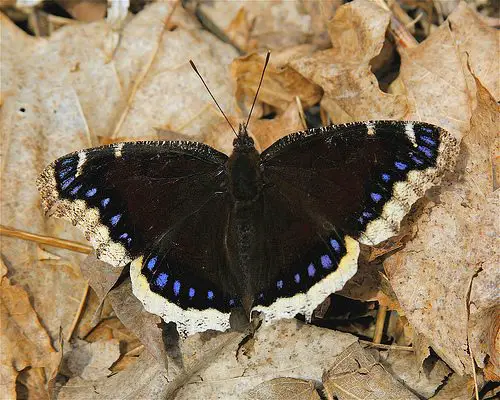
This morning I saw my first butterfly of the season floating above my garden. It was a Mourning Cloak (Nymphalis antiopa), a stunningly beautiful butterfly. It’s not surprising that this species was the first of the season, as one of it’s other common names is “Harbinger of Spring.”
Mourning Cloak Life Cycle
The Mourning Cloak overwinters as an adult, which requires quite a bit of specialized biology. Hibernating adults can survive through the winter by use of “antifreeze” chemicals (glycerols) in their blood. They locate sheltered tree crevices where they will spend the winter.
On sunny days, even while there’s snow on the ground, some adults will emerge to feed on tree sap, especially oaks, and then return to their sheltered winter hiding place.
Prior to these appearances, they use isometric shivering to raise their body temperature to 15 degrees or more than ambient temperatures.
In the spring, the males seek mates by “perching”–finding a sunny spot on a hillside or other elevated spots where it sits and watches for passing females. He will then fly out to intercept her and attempt to mate.
Eggs are laid in groups which circle the twigs of the host plant. Caterpillars live in a communal web and feed together on young leaves, then pupate and emerge as adults in June or July.
After feeding briefly, the adults estivate until fall, when they re-emerge to feed and store energy for hibernation. Some adults migrate south in the fall.
Mourning Cloak Caterpillar Host Plants
This is a generalist butterfly with many varied caterpillar host plants: Willows including black willow (Salix nigra), weeping willow (S. babylonica), and silky willow (S. sericea); also American elm (Ulmus americana), cottonwood (Populus deltoides), aspen (P. tremuloides), paper birch (Betula papyrifera), and hackberry (Celtis occidentalis). Older caterpillars wander about and may be found on plants that they do not eat.
Adults feed mostly on tree sap, especially that of oaks. They walk down the trunk to the sap and feed head downward. They will also feed on rotting fruit, and only occasionally on flower nectar.
Mourning Cloaks in your Butterfly Garden
For this species, your nectar plants are less important than your trees and shrubs. You can encourage this winter-flying butterfly to take up residence in your wildlife garden by planting any of the above trees that are native to your region.
You will be delighted on sunny winter days to witness the magical flight of this butterfly while snow still lingers in your garden.




Submit your review | |