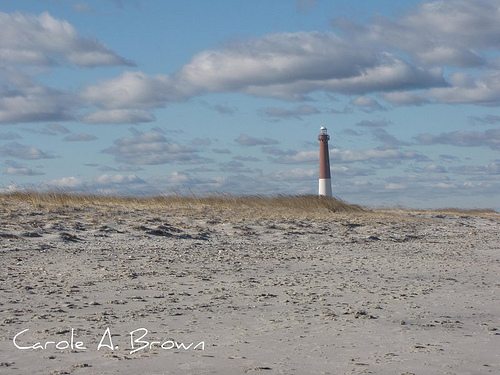
I was fortunate to spend the holiday yesterday at the state park at Barnegat Lighthouse in New Jersey. I have a deep fascination with winter ducks who spend their lives in the cold, rough waters of the ocean. And I consider you extremely lucky if your garden vista includes this scene. To my friends who live by the ocean, thank you so much for sharing your gardens and your beautiful views with me!
I was in search of the Harlequin Ducks who congregate in the surf at the end of the long rock jetty that protects this barrier island from storm surge and beach erosion, but I found a few other treasures along the way.
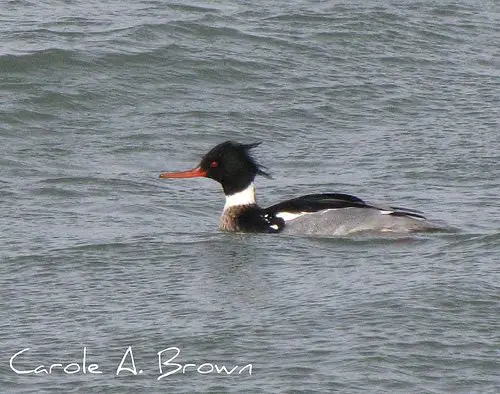
Close to shore we spotted Common Loons and Red-breasted Mergansers.
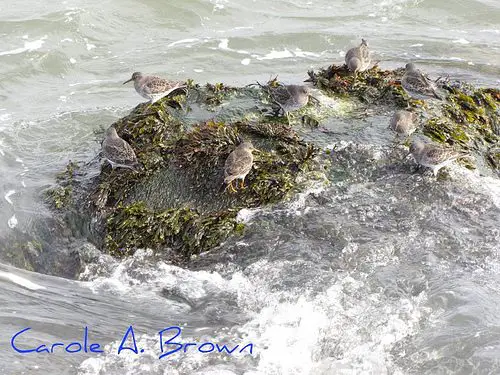
Purple Sandpipers searched for food among the rocks. It was an amusing dance: the waves would crash over the rocks, scattering the birds. But they quickly came back to feed before the next wave crashed.
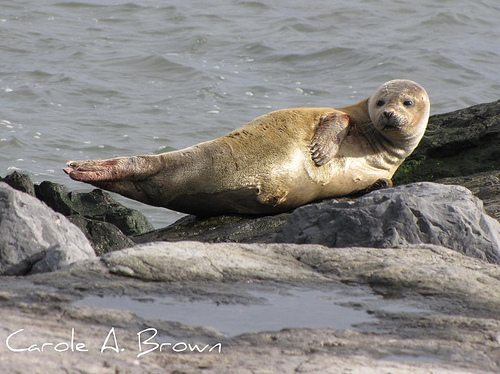
A young Harbor Seal lay perched on the jetty. It took several minutes to realize that this seal was injured. Its front and rear flippers were bloody and it was not moving anything but its head. We called the Marine Mammal Stranding Center, which is fortunately located close by, and attempted to keep the people a good distance away from the seal until help could arrive.
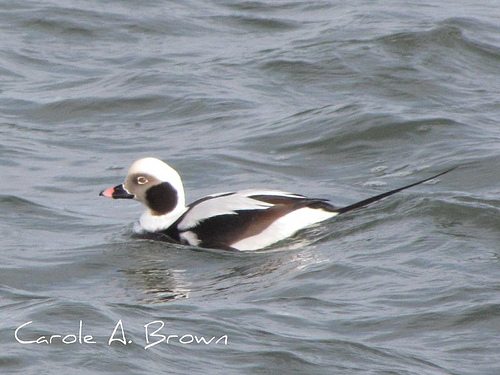
Male Long-tailed Ducks are particularly spiffy.
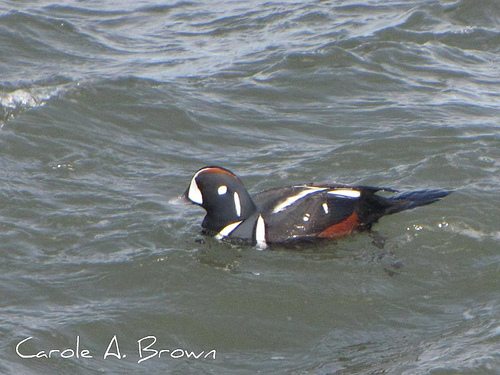
And then, finally, my favorite duck, the Harlequin. I just love these beautiful birds. And the fact that they like to hang out at the end of the jetty where the surf is really rough never ceases to amaze me.
By now, I know you’re wondering what these ocean loving animals have to do with your garden. Sometimes we need to look beyond the garden gate because all actions have consequences. And the consequences of our consumptive lifestyle are huge.
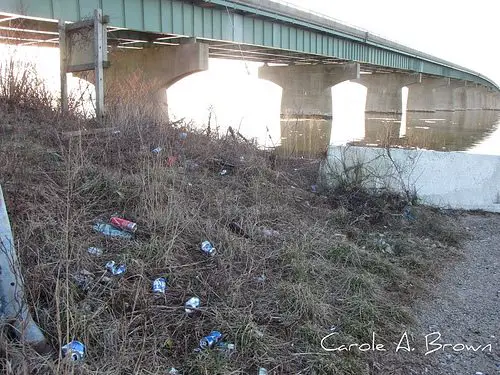
This scene is repeated at shorelines around the country and around the world. In fact there’s a floating island of trash in the Pacific Ocean that is larger than the state of Texas.
This debris is putting the mammals, birds, and other ocean creatures at risk. Please do not toss your trash near our waterways including streams, rivers, lakes, ponds, and other wetlands including the ocean.
Each of us can make a conscious choice to reduce the amount of waste we add to landfills each year. Less consumption equals less trash. Please do your part to help protect the birds, mammals and other ocean life. Their future depends on in, and so may ours.
How are you taking steps to reduce waste? Is the lake, river, or oceanfront near you full of trash? Are you helping to clean up this mess?
© 2010, Carole Sevilla Brown. All rights reserved. This article is the property of EcosystemGardening.com If you are reading this at another site, please report that to us


Fabulous post!
Great post and pictures. Whatr happened to the seal? Did you find out?
.-= wildelycreative´s last post ..Night Tracking on Twitter =-.
Carole, I love your photos. I so much miss the ocean, or sea (as it is called in Scotland).
Even though I live about as far away as a person could get from the ocean, in Kansas, I know that I am connected to it. After all, water flows downhill until it reaches the ocean. Trash from my street and chemicals and pollutants from my garden or roof can get all the way to the Gulf of Mexico. We all need to be responsible and remember this. Thanks for the reminder.
Not to mention what those chemicals and pollutants do to the streams, rivers, and lakes right there in Kansas. Wish you could come to visit. I’d take you to the ocean. I know, where I live is the “wrong” side of the Atlantic for you…….
Carole, I may just have to take you up on that offer someday. You don’t live on the “wrong” side of the Atlantic for me – I’d love to see what the other side looks like. Reading what you have to say about places like Cape May has just whetted my appetite!
Carole,
What a beautiful post! I so miss seeing water – like Alison, Colorado is so land locked. Growing up in Minnesota, land of 10,000 lakes (not puddles like here) we were always close to water. The loons, ducks and other water loving birds were a common sight. Here, about the only water loving birds I see are all of the Canadian Geese leaving their droppings on the playing fields.
As to whether or not this post relates to our gardens, I would say definitely YES. Everything we do is interconnected to our ecosystems, sometimes just not so linearly.
Kathy
Kathy Green recently posted..Happy Holidays 2010
Thanks, Kathy. Sorry about those Geese, though
I don’t know if I could stand being landlocked. I’m only an hour away from the Jersey Shore or the Delaware Bay, plus we’ve got a lot of rivers, streams and lakes close by. I love being able to visit so many nearby habitats
Gorgeous photos, great post! We go for walks on the beach a lot and have made it “a habit” to pick up trash that washes up on our beaches or trash that has been left by the public. We are fortunate not to encounter too much trash on our Treasure Coast in Indian River County, FL. My 11 year old is a member of the Environmental Learning Center in Vero Beach, who has volunteered for clean-ups on preserve islands on the Indian River Lagoon, as well. It comes naturally to us, to simply pick up what doesn’t belong on our shores…
Wilma, kudos to you for teaching your family to be such good stewards of the earth! And kudos to your son for volunteering for cleanup duty! We all have to do our part, and you are a great model for that. Thank you.