
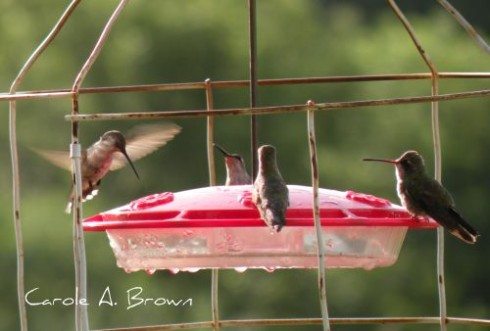
We’ve talked about hummingbird feeders before in discussing how long to leave your feeders up during the fall migration, but this new question came from Stacey:
Carole, is it really okay to feed hummingbirds sugar water? I avoid refined sugar like the plague, so I’m wondering if it’s safe for those tiny bodies. I prefer to plant flowers they like, even if it means a few non-natives (Maltese cross, for example).
Am I being too much of a purist?
What a great question! Especially at this time of the year when the Hummingbirds are flitting all over my garden.
Here’s some rules of thumb when filling your hummingbird feeders:
- DO NOT use that red-dyed hummingbird “food” you can get in the supermarket or garden store. It is thought to cause harm to both humans and hummingbirds and it’s just not worth risking that. Besides, it makes no difference in attracting hummingbirds and it’s expensive.
- DO NOT use honey to make nectar for hummingbirds. Honey ferments and causes a deadly bacterium in hummingbirds.
- Table sugar most closely resembles the nectar found in flowers. This is the feeding method of choice by every hummingbird researcher I know.
- It is very important to clean your feeders out frequently in the summer heat. The nectar can spoil in the heat and cause illness for the hummingbirds. Aim for every other day.
To make nectar for hummingbirds, mix table sugar with water in a 4 to 1 ratio. For example, 1 cup water to 1/4 cup sugar, or 4 cups water to 1 cup sugar.
You can either prepare this on your stove top by boiling the water until the sugar is dissolved. Or you can prepare it at room temperature by stirring the sugar into the water until it is completely dissolved.
Hummingbird feeding in the wildlife gardenWhen choosing a feeder, you want one that is red, is easily cleaned, has built-in ant protection, and is easy for hummingbirds to use. I prefer the Aspects Hummzinger feeder pictured here. It’s easy to use and the hummingbirds love it.
There is also a smaller feeder, the Aspects mini Hummzinger Hummingbird feeder which is great at the times of year when the hummingbirds are not migrating, but nesting in your garden.
You may want to read Attracting and Feeding Hummingbirds, by Sheri Williamson. While there are several other Hummingbird garden books, Sheri Williamson’s is the most accurate. She is also the author of A Field Guide to the Hummingbirds of North America, the essential reference for identifying hummingbirds.
Also, consider adding some of these native plants to your wildlife garden:
- Coral Honeysuckle (Lonicera sempervirens)
- Bee Balm (Monarda didyma)
- Jewelweed (Impatiens capensis)
- Bleeding Heart (Dicentra eximia)
- Wild Columbine (Aquilegia canadensis)
- Foxglove Beardtongue (Penstemmon digitalis)
- Lyre-leaved Sage (Salvia lyrata)
- Turtlehead (Chelone glabra)
Leave Us Your Comments Below!
Click the Submit Your Comments button below to leave us your comments or questions!
More From Ecosystem Gardening:
 Ecosystem Gardening in Practice: Installing a Green Roof
- Do Robins Really Return in the Spring
- Butterfly Bush is Invasive Do NOT Plant
- Ecosystem Gardening How to
- The 5 Pillars of Ecosystem Gardening
- What makes a plant invasive? The first lesson in what NOT to plant
- Japanese Barberry: A Threat to Public Health

Submit your review | |
To all the sugar haters! Sugar is whst is found in nature. Even refined sugar has its purpose. Following the 4 to 1 method is the tried and true, and only, method.
Where liver failure, in hummingbirds, comes in is when some dolt puts more sugar in than is necessary. Some do this to be competitive with a neighbor, who is in turn adding more to pull birds away from your feeder. STOP IT! Like humans, too much sugar is bad for them. If you want to give them some protein, cut up a watermelon, cantaloupe or banana and set it out. It will attract fruit flies, and other insects, the birds feed off of. As stated somewhere else, if you are not going to care for them properly, DON'T PUT OUT FEEDERS!
Piggybacking on a comment about buying nectar at walmart. I did that this week and some spilled on my shirt, BLEACHING IT!. I checked ingredients but can't tell which acid or added supplements could do this. I got the one with no red dye but I feel like this is worse for them. I would not recommend buying store bought feed anywhere. Sucrose far too high in these and planned with preservatives let alone infused vitamins. I may just stick to native plants this year.
NEVER EVER BOIL WATER WITH SUGAR ALREADY ADDED...CAN CREATE CRYSTALS THAT IS TOXIC TO HUMMERS AND MAKES THE CONSENTRATION TO GREAT!!
Another plant native to the US that hummingbirds love his trumpet vine
(Campsis radicans).
Sugar and honey are bad for hummingbirds, plant native trees and shrubs instead
Btw honey down not ferment it is a natural antibiotic .
I am glad to get this right. So now I know the right thing's to do. Thank you for you're information!
Please do not try to feed hummingbirds unless you follow the recommendations of ornithologists and wildlife researchers! The 4:1 formula sugar water has been used by scientists and researchers for over fifty years. I personally go through one to two gallons of nectar a day during the peak season (mid-August to mid-
September here in NM mountains.) Be sure to keep your feeders clean and don’t fill them with more than will be eaten in 2 or 3 days, max! Clean feeders regularly with hot water and an occasional soaking with bleach solution. There should never be anything in your feeders beyond sugar, water and love for life!
Not to be a know it all, but I do have a double Major in Biology and Chemistry, I graduated with a Bachelors in Science in Diagnostic Laboratory Medicine. Sugars (Carbohydrate) metabolism, which there are two categories, simple and complex, is kind of complicated. If one glucose (table sugar) it may not be good for another species. That’s why people can carb load or carb crash. Corn syrup is another sugar, anything ending in “ose” is a sugar like sucrose.
Hummingbirds do NOT eat sugar water in the wild. If refined sugar is bad for humans I can't imagine is very good for hummingbirds. Humans can live off it as well but we are having a lot of problems as a result. There must be something better that the average person doesn't know about. And to the person who said should we feed them Stevia in a sarcastic comment, and of course we don't think we should feed them Stevia idiot, but sugar is not a healthy ingredient for any person or animal.
Best feeder-perky pet pinch-hit Hummingbird feeder best hummingbird nectar is at Walmart-by homestead-Oremiun Hummingbird Nectar Concentrate contain vitamins and cal ium just add water. What ever feeder you are using fill it half full of of this concentrate I mentioned here and half water, the directions are on the back of the bottle. Thos concentrate iam using for the hummingbirds they love it. I now have 2 feeder up because I have been having heavy traffic with hummingbirds ever 5 mins 5-10 mins they are feeding from it and I notice that there have been differant colors. There has bern several of them fighting over it, which u read it is the male and female hummingbirds and they are fighting over their territory, which I will be buying more feeders to solve this issue and placing them in differant areas of my yard. I also have added plants that have the flowers they like to get their natural nectar from which is porterweed,salivias, and lavender. So far I have been getting really good outcome from everything I have in my garden that I have mentioned here. So invest in all these things for the hummingbirds then sit back and enjoy the show they put on because, they are amaz
Birds!!!!
To those of you who didn't actually read the post:
Refined sugar is not colored. It's white. That's because it's as close to pure sucrose as it is practical to get.
No matter what your fad diet says, sugar is not poisonous. It's sugar. Some creatures live on it. Butterflies. Bees. Hummingbirds. Too much of it isn't good for humans, but it is ESSENTIAL TO LIFE for hummingbirds.
No, they don't come back because sugar is somehow addictive -- they come back because THEY CAN'T LIVE WITHOUT IT. Being able to fill up in a minute at a feeder instead of an hour going flower to flower is more convenient for the hummingbird, but those flowers put out the same thing as the feeder: sugar water. That's what nectar *is*.
What on Earth do y'all want to feed your hummingbirds? Stevia? That will KILL them. It contains zero calories. (that's kind of the point) It's great in your coffee, but it will taste like real food to a hummingbird but actually contain no food at all and they will STARVE TO DEATH. I can't emphasize this enough. Hummingbirds need to drink sugar water. They can get it conveniently at your feeder, slowly at flowers, and not at all if a drought or a plant disease kills those flowers.
Beekeepers have been feeding bees extra sugar for centuries. Colony collapse disorder has been a problem for only a few years. There is no connection. Pesticides, probably. Invasive varroa mites, possibly. Monocultures of plants bred for things other than nectar production, possibly. But not sugar.
Sugar water is WHAT HUMMINGBIRDS EAT. It's what they live on. It's what they're built to digest. It's what they get their calories from -- the calories to flap their wings faster than your heartbeat. It is not addictive (except in the sense that food is addictive to anyone who wants to stay alive), nor is it toxic. It is their food.
If you're one of those people who feed artificial sweeteners because you think sugar is poisonous and your hummingbirds starve to death with full bellies, or feed honey because it's natural, just like the botulism toxin that kills the hummingbirds, or leave whatever you feed out there until it grows mold: STOP feeding hummingbirds. They will be better off without you. They might not be as healthy or as numerous, but at least they won't die just trying to get something to eat.
Hummingbirds do not have the same nutritional requirements as humans, and thank goodness for that. I don’t personally love getting my protein from gnats and mosquitoes. It is utterly ridiculous to claim that the effects sugar has on humans has anything at all to do with what is best for hummingbirds. Humans are large mammals whose evolutionarily relevant contact with highly sugared foods was limited to things like finding wild honey, which is extremely rare. This means we are driven to consume as much sugar as possible as fast as possible to stock up calories, but also that we really aren’t meant to be having it all the time. This, combined with the literally constant access to sugar, is a recipe for poor human health.
This is not how hummingbirds work. Hummingbirds are birds, not mammals, and weigh less than a nickel. Hummingbirds are evolutionarily built to live on sugar and insects, all the time, constantly. They have constant access to suitable amounts of sugar as migratory birds who follow the flowers. This is very different from how humans live, and the ways humans are meant to have sugar. They don’t get enduringly obese from sugar like humans because their metabolisms are very different. They don’t binge it and then store it as fat for years as humans do. If it gets stored at all, they store it for a few hours or maybe overnight, as they quickly process it. They burn it much more quickly than you do. What do you do after you eat a cake? Sit on the couch? Go for a light stroll? Maybe you feel guilty and you even jog? Good for you, but that’s nothing compared to flapping your wings numerous times a second as you dart through the air chasing tiny fast moving insects and defending your territory from other birds who are just as fast. They absolutely need the fast, accessible energy to use their absurdly fast musculature to do what only hummingbirds can do. They don’t have the time to break down complex carbohydrates all the time, a hummingbird that is awake and flying is never more than 3 hours from starvation. They need to come feed many times a day not because it’s addictive like it is to humans, but because they’ve already burned it off. They have, for the entire existence of their kind, been doing this the same way. Feeders mimic nectar, but birds still prefer real flowers and seek them whenever possible.
For the love of God, if you won’t give hummingbirds properly concentrated nectar made from plain table sugar and water, then please give them nothing at all, or just a bird bath of water. They’ll starve to death with their bellies full if you give them artificial sweeteners. It could kill them through fermented nectar if you use honey. It could kill them through iron poisoning if you use organic or raw sugar. You will harm the hummingbirds if you attempt to outsmart nature by tricking them into eating something other than just plain sucrose. Nothing about those is closer to actual flower nectar and any perceptions you have of their healthiness is a human thing that means nothing to the birds. Birds aren’t human, and you -will- kill them if you insist on treating them as if they are. What applies to you is not universal, so accept that sugar isn’t as bad for everything on earth as it is for you. Not everything is human, and the extreme diversity in what creatures need to eat to thrive is the reason we may all exist on the planet at the same time. Species colonialism has got to stop, it isn’t good for animals to be treated like people. They have animal needs. I know you all care deeply and are trying to be conscientious, but don’t treat hummingbirds as you want to be treated, fly a mile (or a few hundred, like they do) in their tiny shoes and treat them like a -hummingbird- needs to be treated.
Another comment about the bees. They too swarm my feeders at times. In the morning I find dead and "drunk" bees. If it does that to them, I'm sure it harms the birds...or at the least does not benefit them much...just as it doesn't benefit our bodies much.
I am starting to wonder this myself. We live in California where there are usually plenty of other things to feed on. Then I see on FB Hummy sites dozens of people who are buying heated feeders to feed in snow and ice. Doesn't make sense. If we avoid the sugar, I'm sure it's bad for them as well. And why would they stay around in the snow? Are they addicted? Does it mess up their internal wirings. Not shaming, I have 5 feeders myself, just wondering. If it's not good for them, I will plant more flowers instead.
I live in Scotland and am back from a birding trip to Costa Rica. I was surprised that the hotels and lodges we stayed at had no feeders out. When asked about this the tour guide said that they had stopped the practice due to the sugar causing liver cirrhosis. As a retired veterinary surgeon I was a little puzzled, especially as I can find no reference on-line. Comments please
@Bettesue: check out the article, "Is Sugar Bad for Hummingbirds?" by Ecosystem Gardener. This article answers your question about sugar.
NO!! refined sugar is died and unnatural. don't poison the hummingbirds,, please!!!!
the list of native plants are not for my area; it would be helpful when using the term native plants to identify where they are native to and not tacitly suggest they are good for all areas of the country. thanks for the article though; it is helpful
Beekeepers feed their bees sugar and wonder why they decimated the bee population. Refined sugar of any kind has zero nutritional value. These birds need nectar from plants with high amounts of nutrients. Stop poisoning these beautiful birds for your own visual pleasure.
Alicia
I've noticed that for about a week I don't see hummingbirds each summer - but then they come back. I was told it had to do with nesting.
I too am worried that sugar might actually be bad for them after learning the link to cancer in humans. My hope is that we're not harming them just to enjoy more of them. My hummingbirds love my red coral bells that come up every year.
Alicia
I've noticed that for about a week I don't see hummingbirds each summer - but then they come back. I was told it had to do with nesting.
I too am worried that sugar might actually be bad for them after learning the link to cancer in humans. My hope is that we're not harming them just to enjoy more of them. My hummingbirds love my red coral bells that come up every year.
I've read you're not supposed to feed hummers brown sugar. Why is that? Can it work in a pinch? (It's usually all we have as we try not to use the white sugars.)
I just want to reiterate the comment Stacey had about feeding white sugar to these beautiful creatures when I avoid it as well. My husband is in the process of putting up a feeder and it seems like a legitimate concern. Where might I look to find how closely it mimics the nectar that is essential for their life? It makes me wonder if they don't return because of sugar's addictive properties....... Ugh!
Apologies too because I have no idea what the "rating" refers to!
Hi there,
I live in San Francisco and have been attracting Anna's hummingbirds to my balcony (I live in an apartment) using the Hummzinger feeder and a four-parts water, one-part sugar solution. I've been changing the solution once a week and seeing lots of hummers. This week I saw none, which was unusual and when I went out to check the feeder I was shocked to see it had black mold in it!!! I think with the warming temps my once a week cleaning was no longer often enough. Lesson learned!! But.....my questions are: 1. Did I hurt and/or kill any hummers with my stupid mistake? (I feel so terrible...) and 2. If I put a new clean solution out there, will they ever come back? How will they know that I've cleaned it and that it's now "safe" again? Thanks for any insight you can provide.