
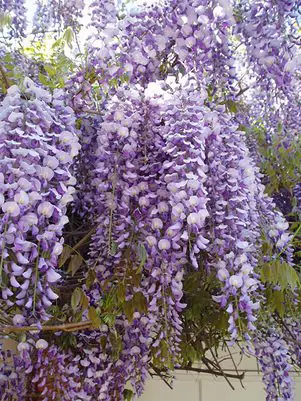
Invasive Chinese and Japanese Wisteria
Chinese Wisteria (Wisteria sinensis) and it’s relative Japanese Wisteria (Wisteria foribunda) are landing squarely on the Most Hated Invasive Plants list.
One of my neighbors across the street has this plant in his yard. Not only is it pulling down the arbor in his yard, it is spreading its runners throughout the neighborhood, even poking its head up through the dirt floor basements in every house on that side of the street.
Needless to say, my neighbors are not happy. This plant is sprouting up everywhere, pulling down fences, arbors, backyard sheds, and even some buildings in its path. Just in my neighborhood, the cost of this destruction is huge.
Chinese Wisteria was first imported into this country in 1816, followed in 1830 by Japanese Wisteria. Because the vines grew fast and provided dense shade, this was a favored plant for porches, trellises, and gazebos.
An interesting fact I learned while researching this article is that Chinese Wisteria twists clockwise around objects in its path, while Japanese Wisteria twists counterclockwise.
Chinese Wisteria/Japanese Wisteria Destroys Native Wildlife Habitats
This vine grows very rapidly, reaching up to 70 feet with 15 inch trunks. Because of this rapid growth and dense shade, native canopy trees, understory trees, and shrubs can be smothered or killed beneath the heavy weight of this invasive vine.
This is especially a problem in the warmer Southern states, where native ecosystems are being wiped out in the path of this aggressive and fast-spreading invasive plant.
The vine curls tightly around the trees and shrubs that it’s climbing, eventually girdling and killing these trees.
The destruction of native ecosystems means that habitat for birds, butterflies, pollinators, and many insects and other wildlife has been wiped out, leaving them no place to make their homes.
Do Not Purchase or Plant Invasive Plants
This problem can be reduced if we refuse to purchase or plant these invasive species, and by politely informing your local nursery or garden center that this plant is highly invasive and that you will not shop at their places of business while they continue to sell invasive plants.
Be polite and gentle. This is a wonderful opportunity to provide education about the dangers of invasive plants to native habitats and the wildlife that is dependent on them.
How to Get Rid of Chinese Wisteria/Japanese Wisteria
Getting rid of Chinese Wisteria is no easy task, because of the huge trunks and fast-spreading habits, you’re going to be working at this task for probably several seasons. Sorry
What you need to do is cut off the vines close to the ground. They will, of course, resprout. Keep cutting back these sprouts until you have effectively starved the root system.
I’d recommend cutting the sprouts back as soon as you notice them because they grow so fast, become quite thick, and are much harder to cut if you let them go.
Native Alternative for Chinese Wisteria/Japanese Wisteria
There is an American Wisteria (Wisteria frutescens), that is native from Virginia to Missouri and south to Florida and Texas. Also give these a look:
- trumpet honeysuckle (Lonicera sempervirens), Hummingbird favorite
- Dutchman’s pipe (Aristolochia macrophylla) Host plant for Pipevine Swallowtail Butterflies
- crossvine (Bignonia capreolata)
- trumpet creeper (Campsis radicans) Hummingbird favorite, can be aggressive, don’t plant next to your house because it can damage your siding.
More From Ecosystem Gardening:





Submit your review | |
Wisteria Sinesis may be invasive if not cared for but it is an important flower for bees!
Thank you for posting this article!
It was interesting to read, but I decided to write what I have found out for myself about Chinese Wisteria which grows right at the ES corner of my house.
At first I did not know anything about it, I saw it overgrown, sprouting next to the ground, shooting these tall new growth 2 m by the few month in summer, growing all the way to the roof and around chimney. It was wild!
I also noticed there are some flowers which smell wonderful.
It looked so aggressive that we decided to cut it down all the way, but keep two shoots which came out further away from the trunk and house.I decided to learn about this plant and see if I can keep it under control as I like it. (British can! Look at their amazing brick or stone home walls in spring!)
I dug out the original as deep as I could, sprayed the leftover root with grass weed killer, covered it with thick rubber mat and left it at that. Nothing sprouted back.
Now, the shoots I trained on a sturdy support and they have become as standards.
I also discovered that Wisteria needs to be pruned up to 3x a year! Twice in summer and once in winter. That’s a normal way of cultivating it and helping to have more wonderful blooms. I love pruning, so I very much enjoy it and it’s super easy.
Once it’s under control, bad things do not happen! They very unlikely(at least in MA propagate from seed. If you see new shoots on the ground(look for them!) just pull them off.
But mainly - PRUNE IT!!!
First, cut it to your desired shape, remove all unwanted offshoots and then just follow normal routine- prune the shoots in July/Aug to 6th bud and Jan or Feb to the 2nd or 3rd bud. It will bloom for you beautifully and will not take over your property.
I have two good things to report about Wisteria - it gives a wonderful and protected nesting place for birds and fixes Nitrogen into the soil.
Enjoy it if you like it, get rid of it- if you do not want to give few hours of your year to care for it!
It was not difficult to get rid of mother plant, either.