
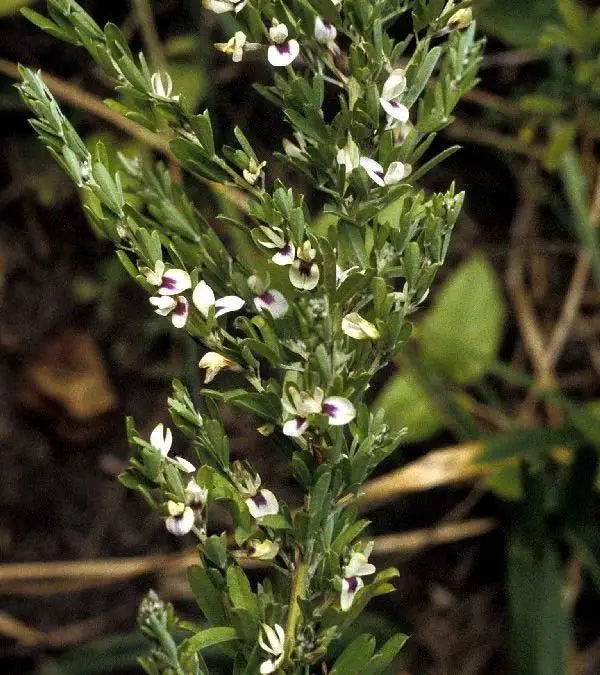
Our continuing feature looking at the worst of the worst invasive plants continues with Chinese Lespedeza (Lespedeza cuneata), also known as Chinese Bush Clover or Sericea Lespedeza. This plant has been listed as a noxious weed and its sale is banned in Colorado and Kansas.
I chose this plant because Ecosystem Gardening has a great friend and frequent commenter in Alison Kerr of Loving Nature’s Garden. So Alison, this one’s for you. Thank you for all your thoughtful comments!
Native to Asia and Australia, Chinese Lespedeza was first introduced to the U.S. in 1899 in Arlington, VA as an erosion control and forage plant. It spread across the Southeast, and now occurs throughout the U.S. and Canada.
It thrives in prairies, roadsides, pastures, and woodland edges, and disturbed areas, and pushes out native plants, destroying native ecosystems. The native prairie ecosystem is one of the most fragile and most endangered ecosystems in this country. This one plant is greatly contributing to that problem.
What it Does in Ecosystems:
- A single plant can persist for more than 20 years
- Plants grow into large stands by spreading root systems
- Because it spreads so fast, it blocks native plants and prevents their colonization
- It thrives during drought because of a deep tap root
- Because of this taproot, it cannot be eradicated by hand pulling
- It has a lot of tannins and other chemicals which prevent other plants from growing
- These tannins make older plants unpalatable to grazers
- It produces a prodigious amount of seed which can spread by wind, water, and animals
- Seeds remain viable in the soil for many years.
It is best controlled by burning in May, mowing a month later, and then applying herbicide in October. But this cycle must be repeated for many years to completely eradicate this noxious plant. The application of herbicide presents additional harms to the ecosystem.
It’s kind of ironic that this plant was introduced with the best of intentions–to control soil erosion because we had already stripped away the original vegetation. But when will we learn our lesson? First stripping away all vegetation causes many problems. Second, we keep introducing plants from outside a plant community where it has none of it’s plant, insect, and other animal predators with the expectation that THIS one will cause no harm, only to discover that it sets off another chain of harmful circumstances.
More From Ecosystem Gardening:
 Why Your Garden is so Important for Ecosystem Gardening
- Top 10 Herbaceous Plants to Attract Wildlife to Your Ecosystem Garden
- Ultimate Guides to a Spectacular Wildlife Garden
- Bee Action
- Pizza Is Great Bird Food
- The New Monkey and your Ecosystem Garden: Everything is Connected
- River Health and Your Ecosystem Garden


Submit your review | |