
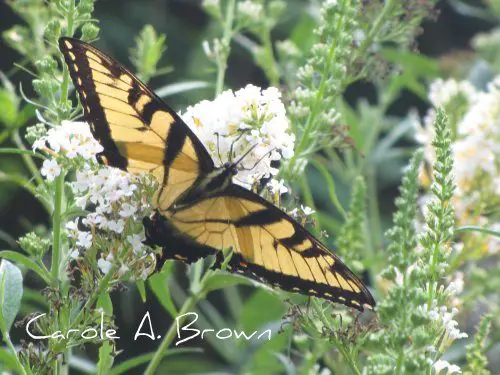
Why ARE they so many Eastern Tiger Swallowtails this Year?
This year there are more Eastern Tiger Swallowtails in my garden than I have ever seen before. In years past I’ve seen one, maybe two, Tiger Swallowtails per day in my garden. This year I’m seeing 10, 15, and even 20 at a time in my wildlife garden.
And in every wildlife garden I visit it’s the same there, too. People up and down the East Coast are remarking on this phenomenon, too.
So, I decided to find out what was going on. When I have any questions about butterflies I go to my friend and mentor Pat Sutton who is a walking butterfly encyclopedia, and her passion for creating butterfly gardens is infectious.
Pat in turn posed the question to her friend and mentor, David Wright. His response is fascinating:
Same observations have been reported through out Pennsylvania. I have no explanation. It’s one of the still unsolved mysteries of invertebrate biology. Population fluctuations are natural; they could be the result of internal genetics (as in small mammals like voles) or the could be the result of a bad year for their parasitoids/viruses (more likely).
A simple average temperature increase doesn’t seem to do it. I did do a literature search on the melanic enzyme pathway in dark morph females. It seems that heat cannot create more black females. But the heat can make the black females a more “dusty” intermediate phenotype. Scattered black scales are converted to yellow.
This search was in response to comments on PA-LepOdes that there were more black females being seen this summer, without a substantial increase in Pipevine Swallowtails. After a week these comments ceased. I think we were observing an emergence of a fresh brood that was atttracted to flower-filled in peak bloom. It’s quite impressive to walk through a large meadow in bloom and see 200 swallowtails.
Tiger Swallowtails peak in April/May and again in July/August, although they can be seen anytime from March to October. So it is possible that the large numbers of these butterflies that everyone is reporting is just the result of this normal peak in their population.
But is it possible that the unnaturally cold (and unnatural amounts of snowfall) affected the parasitoids that normally put a damper on the numbers of adult Tiger Swallowtails?
The thing is, there are many questions about nature that scientists don’t yet have all the answers to. But Mother Nature knows what she’s doing, I’m sure. For now, I will just glory in the sight of these beautiful visitors to my wildlife garden.
More From Ecosystem Gardening:


Submit your review | |
Thank you for the review. I had to research this curious observation for I noticed more butterflies - female Tiger Swallowtails - in Central MD two weeks ago. I was amazed and thought they had emerged earlier than previous years. In my little wooded area, I saw 10-20 which is alot in one sighting, I thought. Thank you. Mother Nature does know what she is doing. Well said.
We have been wondering why we have seen hardly a swallowtail in our yard this year (Shenandoah Valley, Virginia). Last year we had a ton. They all must be up in your yard!
When I lost my best friend back in May of 2018 the sightings of beautiful Swallowtails is when it all began. It was always the trio and from the moment I arrived in Colorado to say my goodbyes with our other best friend is when the Swallowtails began to appear everywhere.
At the house, at the church and even when I returned back home to the DC,MD,VA area.
So to conclude, I would like to think of the reason why I see so many swallowtails this year is in memory of an abundance of love that our dear friend Sharice will forever spread and her spirit will always be with us.
God Bless!
I've noticed a ton more swallowtails (especially tiger) this summer. I am in northern virginia (20171). I usually see a few here and there, but this summer I see them daily and some days it's close to 10.
Hoping someone can answer this....
Can tiger swallowtails mate with black swallowtails? I witnessed this and thought it strange. What color are the offspring? I'm not up on butterfly genetics. 🙂
I've been seeing many more than usual in Green Bay, Wisconsin as well... so many that I actually noticed them and I am not really much of a lepidopterist... also seeing more rabbits than usual... which I know is cyclical.
In NC, north of Raleigh I have noticed a great deal of Tiger Swallowtails as well and was wondering why there were so many. I would see a bunch of them at a time which I have never seen. Thanks for your post.
I've seen 3 this whole season and I live near PA, just across the border in NJ. I've actually been feeling horrified by the lack of butterflies I see everywhere I go. Where in PA do you live?
In previous years would see 10-15 at any time when the honeysuckle and
Butterfly bushes are in bloom. None as in zero this year. Happy that they didn’t disappear everywhere!
I'm seeing way more of the western out here in Oregon this summer, it's crazy, thanks for posting your article