
The majority of my time (and therefore the bulk of what my clients paid me) in various gardens in which I worked was spent removing invasive plants. As a matter of fact, the removal, control, and eradication of invasive plants are a huge expense for many communities, states, and the federal government.
Who pays these bills? Taxpayers do.
This means that a large amount of our tax dollars is being spent trying to control invasive species. In the United States, the estimated cost of controlling invasive species is $138 billion per year, introduced plants cost approximately $23.4 billion in annual crop losses, and invasive species now occupy more than 100 million acres and are spreading at the rate of 3 million acres every year.
There are many beautiful native alternatives to invasive plants. Please check with your local native plant society for suggestion of native plants appropriate for your area.
Many of these out-of-control plants have been introduced by the horticultural trade
Many of these out-of-control plants have been introduced by the horticultural trade for use in our gardens. Our desire to be unique, to possess something new, has created a vast market for the importation of exotic species.
Some of these plants have been used in gardens for more than 100 years prior to them escaping from our gardens, becoming invasive, and consuming our wild places.
The fact that some of these species have been in cultivation in our gardens for so many years before they escaped and became invasive makes the importation of more and more exotic species a scary concept.
How do we know which plant will be named the next noxious pest? Do you want to be responsible for the next invasion?
Most Hated Plants
Some of these plants have become very familiar to most of us: Oriental Bittersweet (Celastrus orbiculatus), Purple Loosestrife (Lythrum salicaria), kudzu (Peuraria montana), Porcelainberry (Ampelopsis brevipedunculata) and multiflora rose (Rosa multiflora).
I’ve begun cataloging some of the worst offenders in the “most hated plants” ongoing feature.
If you live in southern Florida you are probably aware of Melaleuca which is spreading aggressively throughout the everglades, wreaking havoc on native plant and wildlife communities.
If you live in any of the western states, you have spent large amounts of time picking the sharp seed spikes of cheatgrass (Bromus tectorum) from your clothing. Cheatgrass was imported from Eurasia as a promising forage plant in drylands for cattle but has now spread invasively across most of the continental U. S. and causes additional problems because it can increase the intensity of fires.
It is very important that you contact your local county extension office or do a Google search (example “invasive plants in Pennsylvania”) to obtain a list of invasive plants in your area.
Never purchase or plant any species from this list in your garden. Carry this list with you every time you shop for plants. If the plant you are considering is on this list DO NOT PURCHASE IT!
Some plant breeders are attempting to create hybrids of some of these plants which they claim are sterile and therefore are unable to reproduce and cause environmental harm. For example, a “sterile” form of purple loosestrife has been developed, but scientists have shown that these cultivars do produce fertile seeds when they are cross-pollinated by a different cultivar.
The low-down on Buddleia
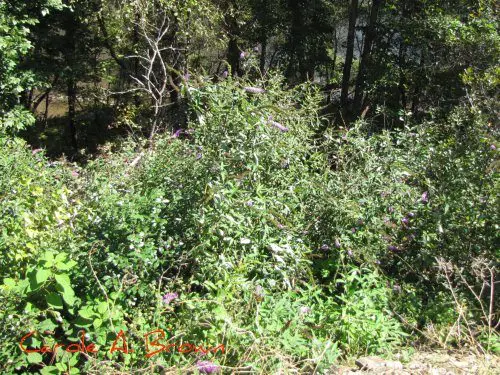
It may come as a surprise to many butterfly gardeners that the number one recommended plant for attracting butterflies, Butterfly Bush (Buddleia davidii and hybrids), is considered an invasive species in many states.
I have seen this myself in West Cape May, NJ, where this species is now appearing in already fragile dune ecosystems. The mere suggestion that this plant should be avoided has been the cause of many people becoming quite upset with me.
How can I possibly say not to use a plant that every book about butterfly gardening and every gardening guru says is the best plant to use to attract butterflies with its nectar? How can all those other people be wrong? It is my stance on the use of this particular plant that has gotten me accused of being a “native plant nazi.”
This plant has become established outside of the garden from New England and Michigan south to Georgia and on the west coast from British Columbia south through California. In Oregon, it is overtaking native plant communities along streambanks because of its dense, thicket-like growth and because it shades out native plants.
The problem with Buddleia is that it produces prodigious amounts of seeds; a single flower stalk can produce more than 40,000 seeds which are dispersed by wind and water. It is imperative if you have this plant in your garden that you deadhead all flower stalks after bloom; do not leave these in the garden or compost them after pruning, they must be thrown away or burned.
Part of the reason that I have such strong feelings about this plant is that no matter how much it is stressed to gardeners that this plant must be deadheaded, very few people actually carry out this task. If we really must have this plant in our gardens, we must each take responsibility for preventing its spread. If you cannot commit to deadheading, then this plant should not be in your garden.
Taking Responsibility for Our Own Actions
Because so many plants that are now considered invasive have been introduced by the horticultural trade, it is up to each of us to take responsibility for keeping these plants out of our little corner of the planet.
It is our responsibility to discover which plants are invasive in our state and not perpetuate their spread by purchasing them for our gardens.
It may be helpful to educate the owners of the local garden center that these plants are causing extreme ecological and economic damage and encourage them to discontinue the sale of any invasive plants. They may or may not be responsive to this, but we can only hope that with enough education of all involved parties that we can slow the spread of these plants.
It is my fondest wish that all nurseries, and especially Home Depot and Lowes (because of their enormous market share) would decide to do the right thing and discontinue the sale of any invasive plant!
More From Ecosystem Gardening:

Submit your review | |
Alright, as passionate, informative, and well intended as this article (and its well educated, and from the sounds of it, just as experienced as my father, a 30 year professional in the horticulture field) is.... this is unquestionably biased to the point of bearly being an opinion piece. Alot of good plants that grow wonderfully and prolifically in their "indigenous habitat" could have (using your parameters on what classifies as invasive) been viewed as invasive. If a plant thrives better than whats already growing well in an area, its not inherently invasive, its just beyter suited there. Yes, it will take time (more than our feeble little life spans will allow us to see) to balance out, but other plants will either adapt, die off in that area, or becime extinct all together. This isnt good, this isnt bad, its calling nature. You can’t tell me an evergreen forest is any different in its affect on the neighboring flora as it became what it is today than a patch of clover or, case in point, a westeria bush. Everything trumps something. Sometimes its harmless, orher times it alters the ecosystem. That doesn't make it negative, it makes your viewpoint either shortsighted or just one sided. I hate fall and can give you 100 reasons supporting my argument that its the worst season of all... but that diesnt maie me right- even if a thousand people agree. Its just nature. And nature, always wins. Go plant something and love your neighbor- and their kudzu. ?
You can't directly comment on someone else's review so I've posted this one just to say that the review below mine, while certainly well intended, is one of the funniest bad takes I've seen in a very long time.
Thanks for making my morning.
Your comments are extremely xenophobic and very problematic. Simply because something is not native to an area does not mean it should not be given the opportunity to grow and thrive. Believing that certain plants are "supposed to" stay in certain places and can't be allowed into others because it won't be good for the supposed "natives" of another region is the same arguments used by racists to keep people of color from coming in to other countries.
Wonderful to read this. Yesterday I got "jumped on" on social media for questioning someone (a well known and respected gardening "expert") for buying English ivy! She didn't understand that it didn't matter that SHE was keeping it in a container, indoors (good luck with that!), but that she, with tens of thousands of followers, was influencing others to buy English ivy just by buying it herself. It is on a list of "please don't buy this plant" in her own location.
I love reading your articles! It is helping me plan what I bring (and not bring) into my newly aquired untouched native land! Thank You! You are not a nazi! People need to know this and you are meant to tell them!!