In a recent article, Genevieve Schmidt described her view of the planting pyramid, and she made several very important points:
- Except for removing invasive plants, no-one is asking you to take away your favorite garden plants
- Adding native plants will help you attract more wildlife
The idea of a planting pyramid brings to mind a recent interview I did with Doug Tallamy, where he discussed turning the current usage of plants in our landscapes upside down.
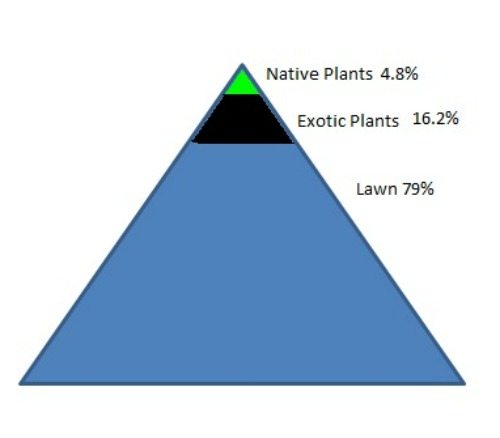
If you look at the graphic above, you’ll see that currently the area occupied by lawn in our landscapes is 79%.
Eighty percent of what we have in our landscapes after lawn is exotic plants, which, while pretty, do very little to support birds, butterflies, or pollinators.
Less than 5 percent of the whole enchilada of our planted landscapes are locally native plants, which offer the most benefit for wildlife.
So what if we turned this pyramid upside down in our gardens? If we were to work to increase the amount of space occupied by locally native, indigenous plants, and decrease the area covered by lawn and exotic plants, we would be doing a great service to the other species that share our world.
We could go a long way to helping our local wildlife in our gardens simply by reducing the area of our lawns. I’m not saying you need to not have any lawn at all, but if we reduced our lawn area by 10% every year, and added more native plants, we’d be creating habitats that would attract more birds and other wildlife.
Choosing the best plants for your wildlife garden does not have to be difficult, and does not mean you have to give up your favorite flowers. With a little thought, you can help to turn this pyramid on it’s head and create welcoming habitat for wildlife in your gardens.
Check out Genevieve Schmidt at North Coast Gardening, or follow @NCoastGardening on twitter.
Check out my new free online course Ecosystem Gardening Essentials, 15 free lessons delivered to your inbox every week, teaching you to garden sustainably, conserve natural resources, and create welcoming habitat for wildlife in your garden.
© 2011 – 2012, Carole Sevilla Brown. All rights reserved. This article is the property of EcosystemGardening.com If you are reading this at another site, please report that to us


I like this as an illustration. It’s kind of sad we homeowners have that much lawn. I’m always thinking that most people don’t use the majority of their lawn for any recreational purposes. The only time they get out on it is to mow it.
Well my pyramid is upside-down and the benefits of having a diversity of natives is too long to list.
Heather
Heather recently posted..Early Flowering Prairie Natives
Heather, kudos to you for turning this pyramid upside down! I’ve been driving past several quite large properties on my way to a project I’m working on and I’m amazed. They’ve got acres and acres of lawn, and it doesn’t appear that they ever even spend any time outside. I wish we could spread the word faster that just because that’s what we’ve always done doesn’t mean there aren’t other ways to do things.
Carole Sevilla Brown recently posted..Journey to Become a Wildlife Gardener
I agree…the lawn takes up too much space, energy, and chemicals. We have been slowly reducing ours over the past seven years. We are lucky that a part of our property is wooded and that helps reduce the lawn as well.
My 3 acres is the inverse of your pyramid illustration and much easier to manage than a lawn! Permaculture!
colette o’neill recently posted..Tuesday 18 May @ Bealtaine Permaculture Smallholding
We got rid of most of our lawn 10 years ago. Last year, I grew more native plants for butterflies. Ours is a normal lot in the neighborhood, so it can be kind of messy–huge carrot blossoms, pokeberry, milkweed, etc. It sure seems like the butterfly bushes are the favorite snack of butterflies! I’ve tried attracting hummingbirds with different flowers to no avail–however this week I will be planting the orange trumpet vine. Since we just installed a pergola, I will have a sturdy structure on which to grow these heavy vines. Next year, I will have hummingbirds!
Nice post! When we moved to this acre of high desert vegetation in 1983, I decided to landscape only 20 percent of it. It’s worked out great. I have a little area of lawn and flower beds (the desert cottontails love these!) surrounded by native four-wing saltbush, sage and other indigenous plants. Consequently I have lots of Gambel’s Quail, Western Scrub Jays, Curve-billed Thrashers and other native birds. I’m very happy with the way this has worked out.