Butterfly numbers plunge by 50 percent

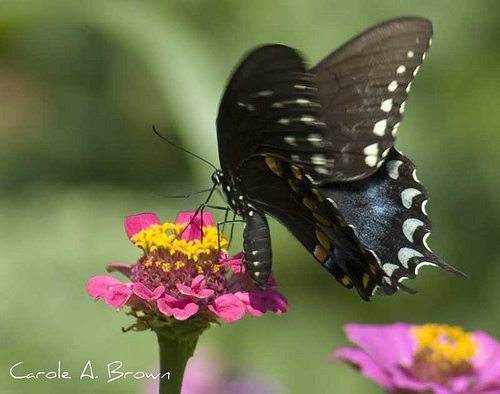
Black Swallowtail

Butterfly lovers have noticed an alarming trend–butterfly numbers are down over 50 percent this year.

The North American Butterfly Association (NABA) has sponsored butterfly counts since 1992, and has noted significant drops in butterfly populations this year.

Pat Sutton is a founding member of NABA and has participated in these counts since their inception. To meet Pat is to discover her joy and passion in sharing her knowledge of butterflys and creating gardens to attract them. She was interviewed in the Press of Atlantic City about the decline in butterfly numbers this year, and she feels that the weather may have played an important role in the lack of butterflies. This spring and early summer were remarkable for overly cool and rainy weather, which may have kept butterflies from flying and finding mates and appropriate host plants.

Watch as Pat discusses this issue:

The decline in butterfly populations has been observed from Canada to South Carolina and west to Idaho and Nebraska, and has been remarked on by scientists and other observers. Although weather may indeed have played a role in the crashing butterfly populations, pesticide spraying and habitat destruction continue to play a significant role in decreasing butterfly numbers.

You have the power to help butterflies in your garden by:

  • Not using pesticides
  • Planting a wide variety of native nectar plants that bloom from spring through fall
  • Planting plenty of host plants. Each butterfly is dependent on a single species or family of plants as a host for their caterpillars. Check a field guide to find which butterflies are native to your area, and choose appropriate host plants for those species.
  • Enlisting your neighbors to help. An easy way to do this is to give them host plants when you divide your perennials in the fall.
  • Joining the North American Butterfly Association Butterfly Garden and Habitat Program
What are you doing for butterflies in your wildlife garden?

Don’t miss a thing! Sign up for Wren Song, the Ecosystem Gardening Newsletter. Coming to your inbox every Wednesday, Wren Song brings you breaking news and tips for planning your Ecosystem Gardening. Just fill in the Wren Song coupon at the top right of this page

© 2009 – 2010, Carole Sevilla Brown. All rights reserved. This article is the property of EcosystemGardening.com If you are reading this at another site, please report that to us

Related Posts with Thumbnails
    About Carole Sevilla Brown

    Carole Sevilla Brown is a Conservation Biologist who firmly believes that wildlife conservation begins in your own back yard. Carole is an author, educator, speaker, and passionate birder, butterfly watcher,  and naturalist who travels around the country teaching people to garden sustainably, conserve natural resources, and create welcoming habitat for wildlife so that you will attract more birds, butterflies, pollinators and other wildlife.. She gardens for wildlife in Philadelphia, zone 6b, and created the philosophy of Ecosystem Gardening. Watch for her book Ecosystem Gardening, due out soon. Carole is managing editor of  Beautiful Wildlife Garden, and also  Native Plants and Wildlife Gardens. Follow Carole on twitter, @CB4wildlife and on Google+

    Comments

    1. That is so depressing. The poor critters are under constant assault from habitat destruction and pesticides, and now the messed-up weather cycles are threatening to push them over the edge.

      Here in southeastern Arizona, it started out to be one of the best butterfly years in more than a decade, building on good summer rains last year followed by moderate winter rain/snow and even a bit of moisture this spring. Our “monsoon” started way early, causing butterfly numbers to spike in mid-July, then the weather pattern broke up and hasn’t been able to restart. The deserts and mountains should look be at their greenest right now, and some areas are still brown. Even my irrigated nectar plants went entirely out of bloom in early August when the heat and drought returned.
      .-= Sheri Williamson´s last post ..Ancient iridescence =-.

      • Carole Brown says:

        Sheri, yes it is depressing when human-caused threats like habitat destruction and pesticide spraying are then compounded by Mother Nature.

        We can’t control Mother Nature, but we can work to lessen the impacts of harms caused by human action by creating welcoming habitats in our gardens.

        It’s a bummer that your nectar plants went out of bloom so early! My guess is that it will take several years for butterfly populations to rebound after this year.

    2. Busyellebee says:

      Hello, Thanks for a great and very interesting post. This year, after hearing about the decline in the bee population, I made an effort to increase the number of flowering plants in my garden, for the purpose of attracting bees. It worked, I’m very pleased to say. But there was also the added benefit of more butterflies in my garden. Before I was lucky to see 3 or 4 a year. During this summer however, I now see a minimun of 2 a day! I have also seen at least 3 different species of butterflies – rather than only the common cabbage white. It goes to show if you make an effort the results can be excellent. Will be adding more flowering shrubs next year -can’t wait :)
      .-= Busyellebee´s last post ..Grass vs Plants =-.

    Speak Your Mind

    *

    CommentLuv badge