
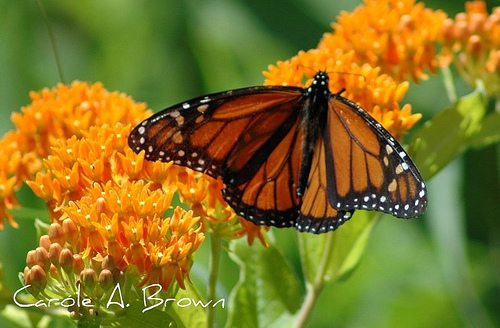
An Amazing Migratory Phenomenon
Every year 100 million Monarch butterflies make an extraordinary journey, some of them traveling all the way from Canada to the Transvolcanic Mountains in Mexico, where they will spend the winter. In the spring they will mate and head north once again. The female will fly until she locates a patch of milkweed (Asclepias), then lays her eggs and dies.
These eggs will develop through the larva and pupae stage until the newly emerged adults will fly further north to a new patch of milkweed and lay their eggs. This process continues until the Monarch is again spread throughout the U. S. and Canada. This continues through the spring and summer, generation after generation of Monarchs looking for milkweed and laying their eggs. In the fall, however, Monarchs do not mate, but instead begin the amazing journey south.
I’ve been in Cape May, NJ during this migration period and the sight of wave after wave of Monarchs floating south above the dunes is a truly breathtaking sight.
This Migration has been Labeled an “Endangered Phenomenon”
Following the discovery and publication of the wintering sites of the Monarch Butterfly much attention has been given to the plight and conservation needs of this butterfly and its amazing migration. The International Union for the Conservation of Nature and Natural Resources (IUCN) announced in 1983 that while the Monarch itself was not considered threatened; the migration to wintering sites in Mexico is an “endangered phenomenon,” the first time such a designation has ever been made.
Threats to Monarchs in Wintering Sites in Mexico
- There are only 11 to 14 known wintering sites. A high concentration of Monarchs in a very few sites makes them vulnerable to natural occurrences such as freezes, heavy rains, and fire which can wipe out large portions of the population.
- Monarchs roost in oyamel fir trees, upon which the local human population is dependent. Heavy logging, clearcutting, and forest degradation alter the microclimate which has served to protect the Monarchs from such weather extremes. Cutting the trees is like poking a hole in the blanket that has kept the butterfly warm and dry for so many generations.
- Five of these sites are protected from logging by government action, but harvesting of lumber is still occurring in buffer zones around these sites. Logging isn’t the only cause of habitat destruction near the overwintering roosts. As local human populations grow near these sites, local landowners also use the lumber for building materials and the cleared land for growing food and grazing cattle.
- As publicity grew following the announcement of the location of the roost sites, more and more tourists began to arrive to visit the sites. Often the trees are so full of butterflies that many of them fall to the ground where unwary tourists step on them. These tourists were also responsible for leaving behind a lot of trash, causing further habitat degradation.
Threats to Monarchs in Breeding areas of the U.S. and Canada
- Monarchs must have milkweed. They have an obligate relationship with this family of plants. No milkweed = no monarchs.
- Many localities treat Asclepius as a noxious weed and is destroyed, usually by spraying herbicide which destroys both the milkweed and adult nectaring plants. This is happens along highway edges, in agricultural setting, and in residential developments.
- Pesticide use kills huge numbers of Monarch eggs, larva, and adults.
- Habitat destruction for development of new roads, housing developments, commercial development, and agricultural expansion have negative consequences for Monarchs.
What You Can Do to Help Monarchs in Your Conservation Garden
- Plant a Monarch Waystation. Go to the USDA Plants database to determine which species of Asclepius are appropriate for your garden.
- Do NOT use pesticides!
- Plant lots of nectar plants for adults. You want to have a continuous supply of different nectar plants from spring through fall.
- Create a new butterfly garden by reducing the size of your lawn.
Actions outside of the garden
- Join Monarch Watch’s Waystation Program, dedicated to creating, preserving, and protecting Monarch Butterflies.
- Support the World Wildlife fund, Mexico’s Monarch Butterfly Reserve:
Recommended Reading about Monarch butterflies
- The Last Monarch Butterfly: Conserving the Monarch Butterfly in a Brave New World, Phil Schappert.
- The Monarch Butterfly: Biology and Conservation, Michelle Solensky
- Chasing Monarchs: Migrating with the Butterflies of Passage, Robert Michael Pyle
More From Ecosystem Gardening:





Submit your review | |
What is the answer to the question Shauna asked in May? I have the same question.
I have a question...
I have a very small milkweed plant and I found 3 monarch caterpillars on it they are all the leaves and are now eating the stems, will they die from no more leaves? They seem big enough to turn into chrysalis.