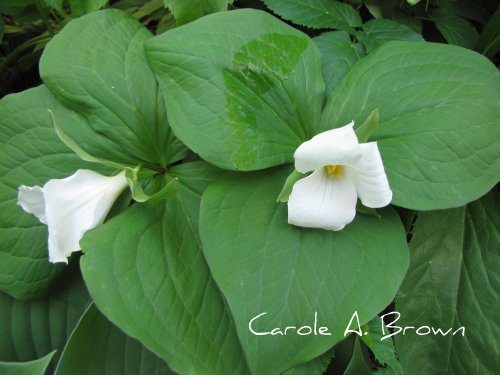
I was chatting last night with my twitter friend @OurLittleAcre, otherwise known as Kylee Baumle, author of the wonderful blog, Our Little Acre. She had a trillium in bloom in her garden, and she wasn’t sure which species it was.
So, using the tools at her disposal, she posted a photo on twitter and asked for help.
You may remember that Trilliums are among my favorite wildflowers, and I had a good idea which one it was (Trillium ovatum), but I checked the USDA plants database and sent my response off to Kylee.
If you clicked that link to the USDA plants database, you may have noticed that Trillium’s common name is “Pacific Trillium,” and you might assume that Kylee lives on the West Coast. But that would be a false assumption to make.
Kylee’s Little Acre is located in Ohio, and she had purchased this Trillium from her local Lowes in a selection of prepackaged “natives.”
Now this totally begs the question “What is native?”
Some suppliers call plants native if they are native to the US. You have to be really careful if purchasing from this type of supplier, though. A native plant to Florida will probably not do very well in your Michigan garden. An Arizona native is not going to thrive in your Pennsylvania garden.
Other gardeners are much more specific about what native means, some will only purchase plants that are native to their state. Some will only purchase plants that have been propagated within a 50 mile radius of their home.
The question is, how do YOU define native?
What criteria do you use when adding natives to your wildlife garden?
I’d love to hear what your thinking is about this. Please leave a comment about what “native” means to you.
© 2010, Carole Sevilla Brown. All rights reserved. This article is the property of EcosystemGardening.com If you are reading this at another site, please report that to us


My garden is less native than it is water-wise. It wouldn’t be very pretty if it were because most New Mexico natives look more like weeds than anything else. However, most are native to the southwest, Texas and Northern Mexico, or the plains: penstemons, woody sages, agastaches, coneflowers, yarrows, desert mallows. But there are also plants that are native to other dry climates of the world like lavender, rosemary and thyme from the Mediterranean, rushia, a long stemmed ice plant from Africa, harebells from Scotland, poppies, and sages from Romania, Kashmir and Turkistan. Nepeta is also an Old World native. As long as the plants are non-invasive.
Water is such an endangered resource in the Southwest that I totally congratulate you for planting a water-wise garden! That is so important, especially in your area of the world.
I live in Florida and the Florida Native Plant Society provides a whole discussion on this very subject regarding Florida native plants which can be found here: http://fnps.org/pages/plants/definition.php
The following was approved by the FNPS Board Of Directors in 1994
“For most purposes, the phrase ‘Florida native plant’ refers to those species occurring within the state boundaries prior to European contact, according to the best available scientific and historical documentation. More specifically, it includes those species understood as indigenous, occurring in natural associations in habitats that existed prior to significant human impacts and alterations of the landscape.”
I use the Institute for Systematic Botany Atlas of Florida Vascular Plants as the authority for determining what I notate as a Florida Native Plant on my blog and also in tweets. The database can be found here: http://www.florida.plantatlas.usf.edu/
Personally, I’ve been sticking to plants propagated within a 50 miles radius of my home because I’ve not had luck with native plants from the big box stores and I’m sick of “murdering” poor innocent plants that don’t get to decide where they want to live. Seems provenance plays a vital role in determining what makes it or not…at least in my yard, so I stick with a local native plant nursery.
Loret aka @PineLilyFNPS
.-= Loret aka @PineLilyFNPS´s last blog ..Embrace your bugs =-.
Wow, Loret, I’m so impressed by how thorough you are in doing your homework prior to purchasing your plants!
For me, a native is a plant that is native to the region I live in. I would not consider Kylee’s trillium a native for my Alabama garden.
Kudos to you for knowing which plants are native to your region!
Interesting discussion, Carole. What I do is follow Allan Armitage’s book on Native Plants for North American gardeners, but also exercise common sense. Obviously a native that is only hardy to zone 7 or 8 is not going to be happy in my zone 5, erratic-winter garden. The trillium that are native here include T. erectum, T. undulatum and T. grandiflorum, but I also have T. luteum in my shade garden because it’s hardy here and is unusual and lovely.
Now, my garden is not ALL natives, but I do have a huge number of natives, including many that are native to Nova Scotia. I’m just writing a profile for a client on a particular plantsman who is a huge advocate of native plants in our region, and we’re seeing more people embrace them now in home and commercial gardens/landscapes.
It’s so encouraging to see native plant nurseries opening up all across the country. They need our support because it’s really hard to compete with the big box stores.
Interesting that most of us agree that natives are what is native to our regions, while large market vendors call it a native if it ever grew in the United States. I think for them it’s about convenience of getting plants and then marketing plants.
I think this is one area that Master Gardener groups could do some good work about educating the public.
I have same issue with big box stores and their tags that indicate sun or shade tolerance. Picked up a lithodora the other day marked full sun. Maybe fun sun in Ohio or Michigan. Full sun in Alabama and it would be a crispy critter by late July.
This is why I’m no fan of the big box stores. They continue to sell so many invasive plants and they are not a good resource at all to learn about what plants really are appropriate for each region. I think they have one buyer that chooses plants for all of their stores. This is not really the best path for gardeners with specific garden conditions.
That’s an interesting question. My own answer–and the reason I define my own gardening style as “kinda native”–is that before I plant it*, a plant needs to be A) from at least the same continent, and B) pull its own ecological weight.
Being from the same continent, here in North America, is an absurdly broad category, and I don’t delude myself that my pineapple sage, coming from Mexican cloud forests, is a native of North Carolina. I’m a little more catholic on the anise hyssop…that’s…native-ish? I could drive to a state that has it without stopping for gas, anyway. But some stuff from the tallgrass prairies fits fine in my little Piedmont prairie planting, I’m lousy with Texas natives, which generally do great here, and a hybrid with at least one American parent is usually good enough for me to put in the main garden bed…as long as it pulls it’s own weight.
I’m not a purist. People who only plant seeds collected within sixty miles of the house–well, I admire their dedication, but I won’t be emulating it.
The pulling-the-own-weight argument is one I recall from “Bringing Nature Home” which addressed the very common question of “But isn’t this native by now?” over naturalized plants. (I guess these people just don’t understand evolutionary time scales–300 years seems like a really long time to us, so it’s counter-intuitive that bugs will still find the plant useless as a host…probably for many thousands of years to come.) To be a worthwhile plant, for me, somebody has to USE it. Drinking the nectar, hosting in the leaves, eating the seeds…whatever. Preferably more than one–nectar’s cheap, after all. So I’ll plant fennel and dill for butterflies, even if they’re not natives, because they’ll do some ecological lifting on the caterpillar front. (That still doesn’t make them native, but it does make them useful.)
*Well, before I plant it without guilt, anyhow. I still plant non-natives for my own aesthetic and culinary purposes, but I try to keep it about 2/3rds natives, and 1/3rd well-behaved immigrants. Also, I collect salvias. I’m weak.
.-= UrsulaV´s last blog ..Two vignettes with plants =-.
Ursula, although I’d like to be a purist, I must admit that I am not. I have happily planted many gifts from friends over the years, knowing full well that they weren’t native, but at least they weren’t invasive thugs. When I purchase plants, I choose natives but I simply cannot stick to the 50 mile radius rule because some plants that I really want to add to the garden simply aren’t available from a source that close.
The plants I specifically want are definitely ones that someone will USE. That’s my criteria for picking plants, too.
Great comment Ms. Ursula, and Ms. Carole, your post about natives is quite relevant to a discussion I started on the Business of Garden Writing Facebook page. Actually, all of these comments are relevant to that discussion. So much could be written about the subject, and I’m sure there’s plenty of books out there. I should read my copy of “Bringing Nature Home” more thoroughly.
I’m curious to know if growing a plant just because you like to look at it can be considered a “use” for that plant?
And don’t most local nurseries sell plants that will do best in the growing zone of their business? I’ll have to talk with a couple of greenhouse and nursery owners and ask them that question. What should I ask? “Do y’all grow local, regional, state and/or national native plants?”
For me, native is what grows specifically around me — preferably within walking distance and also where I can gather seeds or seedlings or (with permission) can dig something up for transplanting into my yard. What is “native” to me has narrowed hugely over the years as I found that things that are not plentiful around me are “targeted” by deer and other animals and voraciously eaten as “gourmet”. When there’s an abundance of something nearby, my yard remains a feeding place but doesn’t get wiped out!
Great question Carole. I buy my native plants from a local nursery which specializes in them.
When I planted my woodland and prairie garden, nine years ago now, I bought from a nursery which had both an extensive range of natives and also non-natives. I used their thick catalog, which detailed native status and growing conditions, flower color and season, to pick out a mixture of plants. It was quite a lot of work.
That particular nursery stopped selling natives. Now, as I plan my rain garden full of natives, I am using the extremely comprehensive website of another plant nursery to pick plants. This one sells Missouri natives exclusively. Although I’m in Kansas, I’m literally 0.5 mile from Missouri. If they sell it, I’ll consider planting it.
Within the Missouri natives, I look at the growing conditions plants need before picking them for my garden. The website I’m talking about does detail which areas of Missouri the plants are native to, but I’m not purist enough to pay attention to that, provided I meet the growing conditions. The nursery is about 20 minutes drive from my home and their plants come from Missouri stock.
I do also peruse the USDA plants database quite frequently. That’s where I tend to go if I want to know whether a plant is native to Kansas. And I study field guides in my “spare” time to learn about native plants.
On recent visits to local non-native plant nurseries I’ve seen very few natives, even at the nursery which has Grow Native signs (a Missouri program which encourages the planting of natives). They only have things like purple coneflowers, sedum, butterfly weed, and some ferns – some of the very well known and showier natives.
I do plant non-natives, but they are for my own food. And my garden contains a number of non-natives which I’m planning to remove at some point – yew, burning bush, barberry, hosta, vinca.
I’m about to remove two Scots pines which are sick and are also inhibiting a 15 year old native red oak. I’m agonizing over what to plant as a screen from my neighbor – there isn’t a native evergreen choice which can fit in that space without affecting the oak. I am going to have to make an exception and plant an arborvitae or deal with my neighbor’s house being very visible all winter.
.-= Alison Kerr´s last blog ..Back Yard Makeover – the plan =-.
Have you considered a Southern Wax Myrtle?
It’s native to Arkansas, it’s an evergreen, it grows like gangbusters in poor soils, and the birds love the berries. They’re also common and fairly cheap at garden stores, and recommended as privacy hedges. I dunno if it’ll do exactly what you need, but it’s bound to be better than an arborvitae…
.-= UrsulaV´s last blog .. =-.
Thanks for the suggestion UrsulaV. I looked up southern wax myrtle and it seems a wonderful plant, except that it likes zones 6 and above and I’m in 5b. I will however check my garden store (the local, non-native one) to see if they have them because they may be OK here despite the recommendation.
I also found Morella pensylvanica, nothern bayberry, which is a more northerly relative, at least on the east coast. That might work as it’s probably more cold tolerant and it seems to require less moisture also, from what I read.
I’m no purist. My garden is “as native as possible”. While I try to emphasize local native plant types, the honest truth is that I can’t positively identify more than a few plants, and neither can the people who want to share the “native” plants that they have in their yards. The best I can do is to order natives from the most respectable mail-order nurseries I can find. Even theogh their plants may be from half the country away, I can be mose certain of what I’m getting than when I collect seeds from down the street.
Two other concerns work against me: there is no way to have a diverse veggie garden that only contains natives, and as an artist, I am not entirely comfortable with the constraints that a strictly native garden would put on me. When choosing from a broader array of plants, I consider a plant’s invasive potential first and formost. It it’s likely to be a green troublemaker, I don’t invite it in.
Like I said, “as native as possible”.
.-= Michelle Clay´s last blog .."Superweeds" =-.
Remember: just because it is named Pacific Trillium doesn’t mean it’s native only to the Pacific coast. That may be where it was first seen or discovered. But this is a very good question about what is native.